Saturday, September 22, 2018

DANCING Down the STREAM: Movement Activities about Water

Dancing is a fun and enriching arena for teaching children STEM concepts.  In this lively lesson, we will study many aspects of water.  Dance adds the "A" for the Art component, and using books and stories adds the "R" for reading,  to complete the idea of STEM to STEAM to STREAM!  

I have created two movement activities based on the following books:

Make a Splash, by Catherine Berger Kaye and Philippe Cousteau, Free Spirit Publishing, 2013

Water is Water, by Miranda Paul, Illustrations by Jason Chin, Roaring Brook Press, 2015


MAKE A SPLASH Dance Story
Based on the Section From "Stream to Sink"

Have you every wondered where the water from our faucets comes from? This dance story will help us to learn about it!  

Read the short section of the book on page 29.  Put on some quiet instrumental music for the background of the activity, then begin:

Let’s brush our teeth. Put toothpaste on your toothbrush, brush those teeth, up and down, turn on the water . . .
Wait, where does that clear, cool water come from?

We will find out! The water from our faucet starts out in a lake, reservoir, or river near your town, or maybe from a well in the ground.  Let’s visit a lake and then see where it goes!

Here we are at the beautiful lake.  Let’s take a boat ride.  Climb aboard! (sit on the floor cross-legged, and imagine you are rowing a boat).  
Sway back and forth when there is a wave!  Let’s paddle all the way across the lake.  Look at those pipes!  That is where water starts its journey to your sink.  Now, let’s jump out and swim back! How many different strokes can you do?  Swim all around the room.

The next stop for our water is at the water treatment plant.  This is where the water from the lake gets cleaned and filtered. Imagine you are the water flowing through the pipes that takes it to our homes and other buildings.  

What would that feel like? What would it sound like?  Can you make the sounds of water swishing and flowing through pipes?

Next, smaller pipes are going to carry you to your sink!  Let’s imagine we are following the pipes that are underground, under the streets, parks, and buildings.  Up above, we hear cars, then a playground, and children playing above us.  What else do you think is above us?  Keep going – the water can flow fast!   Let’s each move in many different directions, imagining we are flowing through the system of pipes underneath a city.

You have finally arrived at your sink!  Imagine you are a drop of water, and you plop into your sink at home.
Finally, swirl and swirl and imagine that you are slowly spiraling toward the drain. That was a long journey!  To finish our dance story, gently fall to the floor and imagine you are a puddle.


WATER IS WATER Dance Story

Here is another dance activity about water in all of its various forms.  Read the book Water is Water.  Put on some quiet instrumental music for the background of the activity. Use the text of the book mixed with movement prompts as you retell the story and add lots of ideas for the children to explore:

Water is water . . . Can you imagine you are water?  Flowing, slowly, then faster. Think of all the different places you have seen water, and move like water as it travels slowly in a river, or quickly over a waterfall.

Unless . . . it heats up and becomes steam.  Whirl, swirl, curl, feel lighter than air.  Rise and fall, move as quietly as you can.

Steam is steam unless . . . It cools high in the air.  Can you imagine you are a cloud?  
Can you change slowly from one shape to another, just like a cloud on a lazy summer day? Move silently across the sky as you change into many different shapes.

Clouds are clouds unless: they form low . . . imagine you are misty fog . . . Twist, curl, uncurl, go high and feel light, and low as you feel heavy.  

Fog is fog unless . . . it begins to fall.  What is it? Rain!  Fall fast and slow, heavily and lightly.  Blow back and forth in the strong wind.  Now put on your raincoat and rain boots.  Run quickly as the fat raindrops fall on you.  Now let's splash in the puddles!


Rain is rain unless . . . puddles freeze! Let’s imagine the floor of the room is covered in a sheet of ice.  Put on your skates!  Skate forward, backward, make patterns like figure 8’s with your feet. Can you balance with one leg behind you? 
Can you turn?  Faster?  Let’s play ice hockey!

Ice is ice unless . . . it is snowflakes!  Imagine you are a snowflake.  What shape snowflake are you?  Let the cold wind carry you, as you glide, turn, swirl, and blow.  Gently fall to the ground.  Make footprints in the snow.  Now let’s build snow people!
Pack the snow, roll, first a big section for the base, then make smaller sections, and put one on top of another. What will we use for the face?   Now let’s go sled-riding.  Let's throw snowballs!

Snow is snow unless . . .spring comes back!  Let’s imagine we are a creek.  We begin on the top of a high mountain as melted snow.  Then we come tumbling down the mountainside, over rocks, waterfalls, and rushing through the valley. Now we will play in the mud. Squish, slip, slide. 
  
Let’s pick apples, like the children in the story.  Climb the ladder, reach for the big juicy apples!  Now let’s jump into the lake.  
Go for a swim in all of that lovely, soft water on a summer day. Float on your back and look at the clouds as they drift across the sky.


Keep on Dancin',

Connie
Moving is Learning!


Saturday, September 15, 2018

Montessori-Inspired Fire Safety Unit Using Free Printables

By Deb Chitwood from Living Montessori Now 

Fire safety is one of my favorite fall themes. September is National Preparedness Month, and October has Fire Prevention Week and Fire Prevention Day. Either month is a perfect time to focus on fire safety. And it's great to have a mini unit at any time of year to review fire safety ideas.


This unit will be for preschoolers through first graders, although older kids could love some of the activities as well! At Living Montessori Now, I have a long list of free fire safety printables. The free printables include my latest subscriber freebie (a Montessori-inspired fire safety pack). Here, I'm sharing ideas for using free fire safety printables to create Montessori-inspired activities for preschoolers through first graders.

 You'll find many activities for preschoolers through first graders throughout the year along with presentation ideas in my previous posts at PreK + K Sharing. You'll also find ideas for using free printables to create activity trays here: How to Use Printables to Create Montessori-Inspired Activities. At Living Montessori Now, I have a post with resource links of Free Printables for Montessori Homeschools and Preschools. 

Disclosure: This post contains affiliate links (at no cost to you).

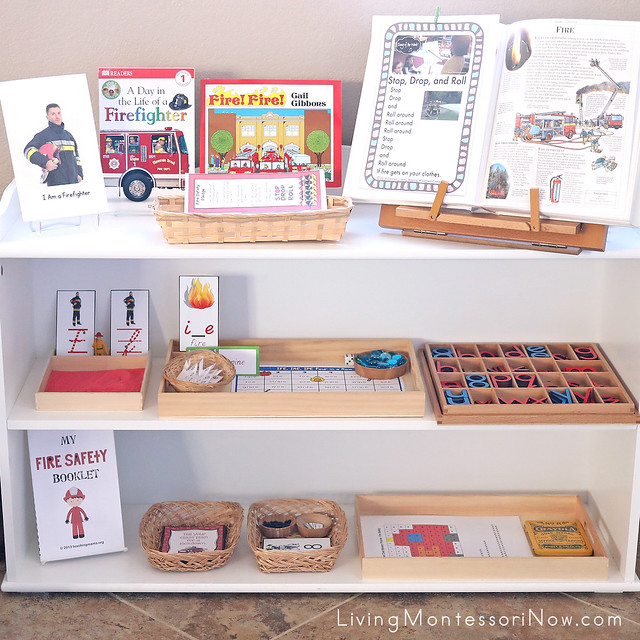
Montessori Shelves with Fire Safety Themed Activities

Montessori Shelves with Fire-Safety Themed Activities

You’ll  find Montessori-inspired fire safety themed numbers, letters, and and more (part of my subscriber freebie pack, so just sign up for my email to get the link and password … or check the bottom of your latest newsletter if you’re already a subscriber)

I always have related books available throughout a unit. I often have at least one encyclopedic type of book available for each theme. On the far right of the top shelf, I have the Random House Children's Encyclopedia. It's from when I homeschooled my now-adult kids, so it's out of print, but most of is still great information (such as the page on fire).  Of course, I don't use it if a particular topic would have outdated information. 

I also have the free printable "Stop, Drop, and Roll Around" Song (subscriber freebie) from Carolyn at Magical Movement Company available on the shelf. An MP3 of the song is a subscriber freebie, too, and we'll be singing that and practicing stopping, dropping, and rolling around to put out clothing that's on fire. You could mix your fire-safety-themed activities among your shelves according to curriculum area. Or you could have a special fire safety-themed area something like the one pictured. My shelves this month have a mixture of skill levels. Many of the activities can be adapted for a variety of levels. If you’re a homeschooler, just choose the activities that work for your child’s interests and ability levels. If you don’t have room for all the activities you’d like to do, simply rotate them.

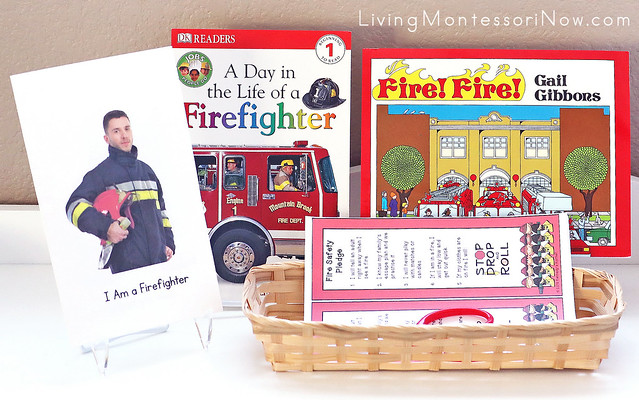
Fire Safety Books and Free Fire Safety Bookmarks 

Shelf with Fire Safety Books and Bookmarks  

Free Printable: Nonfiction Book for Kids: Firefighters from The Measured Mom 

Free Printable: Fire Safety Bookmarks by Kennedys Korner at Teachers Pay Teachers 

I love the printable Firefighters book because it has photographs and is an easy book for kids to read. There are 3 different types of bookmarks in the bookmark printable. It's a super-easy activity to prepare, yet gives extra cutting practice and a good reminder of fire safety tips. I like the idea of the child giving bookmarks to friends and family members as a way of helping them stay safe, too. A Day in the Life of a Firefighter and Fire! Fire! are both Montessori-friendly books that give interesting information about firefighting. I have a number of other fire safety books in book baskets.

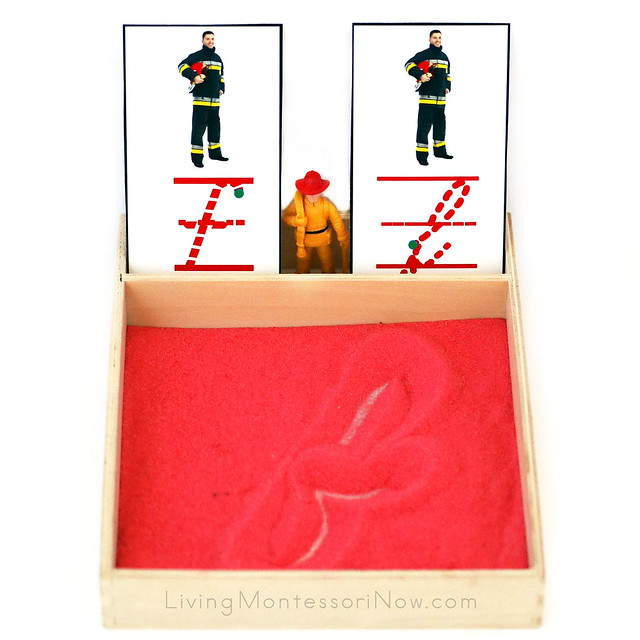
F is for Firefighter Sand Writing Tray

F Is for Firefighter Salt Writing Tray  
Free Printables: Firefighter Letters for firefighter writing tray (part of my subscriber freebie pack, so just sign up for my email to get the link and password … or check the bottom of your latest newsletter if you’re already a subscriber) 

For the sand tray, I used the wooden tray from the Melissa & Doug Lace and Trace Shapes. You can use whatever tray or container work best for you, though. I had gotten some lovely white sand for making kinetic sand and other projects. I like that it was so easy to make a bright color simply by adding gel food coloring and some water. I spread it on a baking pan to dry overnight. If your sand isn't already sterilized, you might want to heat it up at  a low temperature in your oven to partially dry it. 

For interest, I added the firefighter from the Safari Ltd. People at Work TOOB. 

If you would like help with introducing phonetic sounds, introducing objects with sounds, or beginning phonics in general, check out my DIY Beginning Montessori Phonics with Preschoolers.

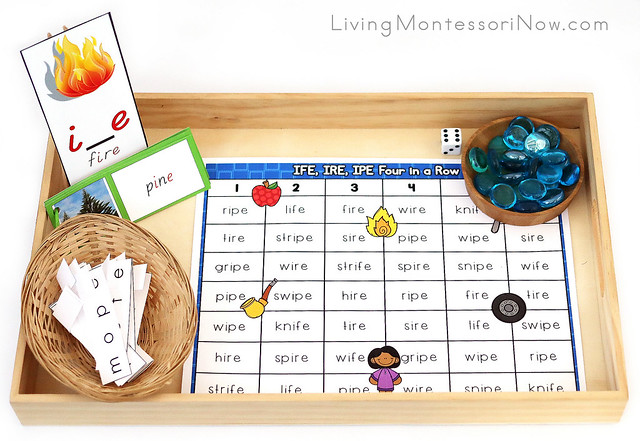
Silent e Game and Activities

Tray with Silent e Game and Activities  

Free Printables: i_e fire font card (part of my subscriber freebie pack, so just sign up for my email to get the link and password … or check the bottom of your latest newsletter if you’re already a subscriber) Note: I have two options of phonogram cards. I have i_e if you like to introduce fire as a silent e (or bossy e) word. Most do that. Some like to introduce fire as an "ire" word ending (vocalic r). From my experience, almost all children can read "fire" easily as a silent e word, so that's the option I use. 

Free Printable: Green Series i_e Letters from MontessoriSoul (Print two sets if you want to use the pictures for movable alphabet word building.) 

Free Printable: "Bossy E" Word Cards from Montessori Print Shop 

I used the free printable Word Family Four in a Row: Long I Word Families by Ford and Firsties on Teachers Pay Teachers. It got switched to a paid product sometime this week, so it's no longer free. If you want a free game, there are a number of free silent e games on Teachers Pay Teachers. 

I love to use glass gems (flat marbles) for activities. These activities were all very simple to prepare. I just added the Multicraft tray and Montessori Services basket for the materials. 

Each of these activities could be introduced as a separate activity or tray. We were using this as more of a review (and I have a limited amount of shelf space), so we combined activities on the same tray. 

First, we analyzed the i_e fire card. Then Zoey read each of the i_e words in the booklet. After that, we went through the Bossy E cards. They make the concept very clear. "Bossy e makes i say its name."


Working with Silent e Words
  
After that, we played the four in a row game. We played it as a collaborative game so that Zoey took a turn and then I took a turn tossing the dice and choosing a word to read from that numbered row. After we reached four in a row, Zoey wanted to continue until we filled the whole card!

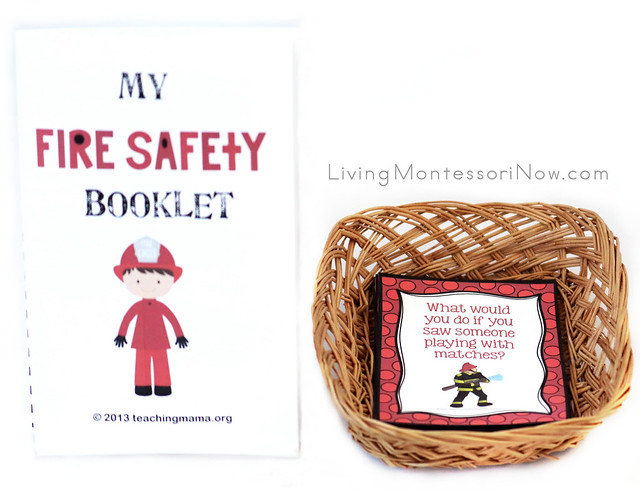
My Fire Safety Booklet and Fire Safety Task Cards

My Fire Safety Booklet and Fire Safety Task Cards Free Printable: My Fire Safety Booklet from Teaching Mama 

Free Printable: Fire Safety What Ifs: Task Cards to Practice Thinking through Emergency Situations by Elementary Matters at Teachers Pay Teachers 

"My Fire Safety Booklet" is a cute activity book that reinforces fire safety. The What If Task Cards have lots of important fire safety topics. I would turn the cards over and take turns drawing a card and answering the question. They're great conversation starters!

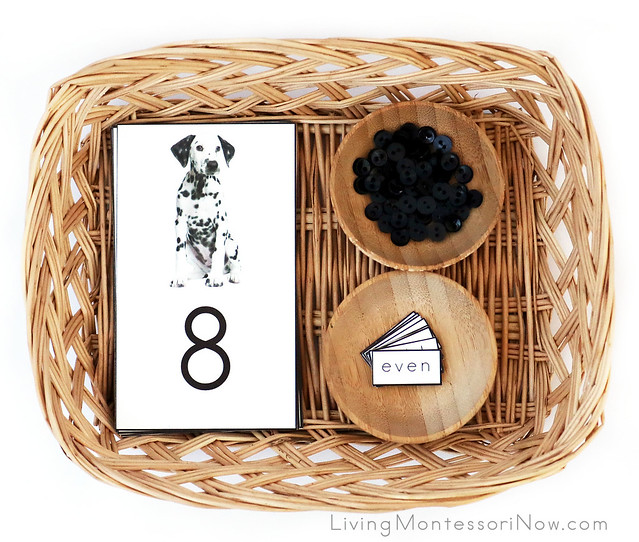
DIY Dalmatian Cards and Counters and Odd and Even Labeling Activity

Basket with Dalmatian Cards and Counters Plus Odd and Even Labels  
Free Printables: Dalmatian Numbers and Odd and Even Labels (part of my subscriber freebie pack, so just sign up for my email to get the link and password … or check the bottom of your latest newsletter if you’re already a subscriber) 

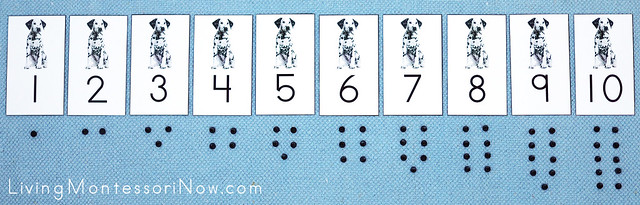
I love making DIY themed cards and counters to introduce odd and even and add interest and variety to cards and counters. I found these micro (6mm) buttons that are an inviting way to represent the Dalmatian's spots. You need exactly 55 buttons if you want to do the numbers and counters 1-10. The package contains 100 buttons, so there are even some left over. 

Dalmatian Cards and Counters Layout  

For Zoey and other kids who are already comfortable with symbol and quantity, I’ll typically use the cards and counters for hands-on addition, subtraction, and other mathematical operations. (See some of my other themed posts for ideas.) But sometimes I like to use the odd and even labels.

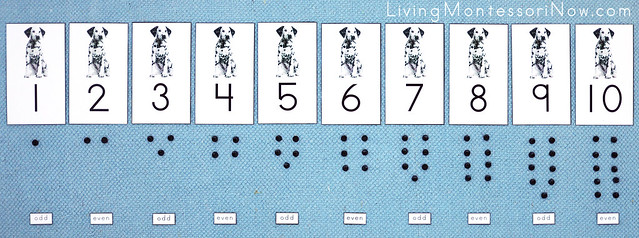
Dalmatian Cards and Counters Layout with Odd and Even Labels

In the Montessori-inspired fire safety pack (subscriber freebie), you'll find a page with odd and even labels that can be used with the cards and counters to reinforce the actual words “odd” and “even.” It’s a great way to be sure readers understand the concept of odd and even. I typically use the larger labels for cards and counters. Because the buttons were so tiny, I decided to use the smaller labels (which are normally for hundred board activities).

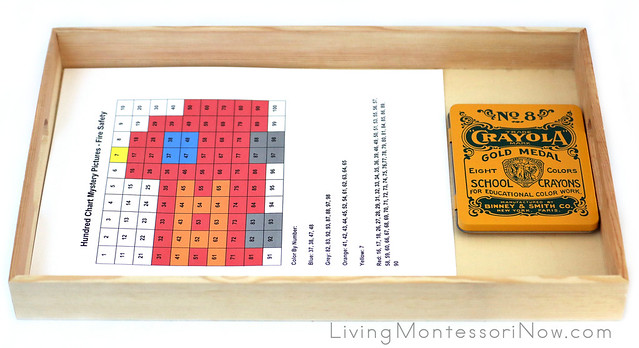
Fire Engine Hundred Chart Art

Tray with Fire Engine Hundred Chart Art  

Free Printable: Hundred Chart from Worksheetfun.com 

Free Printable: Hundred Chart Mystery Picture - Fire Truck (code and control picture) by Jessica Hermann at Teachers Pay Teacher (Note: The actual hundred chart doesn't come with the printable that's shown on the tray. So I added a link to a hundred chart that should work well. 

For younger children, I like to use glass gems (flat marbles) and use hundred chart art as color matching/fine-motor work with the added benefit of the child seeing the numbers 1-100 in place. For older children, you can use this as a fun extension to hundred board work where the child colors in the correct colors to reveal the mystery picture. If you want the design to be a mystery picture, just cut out the code and only have your child see that until your child wants to check his or her work.

More Free Fire Safety Printables

Go to my post at Living Montessori Now for links to free brain and growth mindset printables from around the blogosphere: Montessori-Inspired Fire Safety Unit with Free Printables and Activities. And be sure to subscribe to my email list if you'd like to get an exclusive free printable each month (plus two more awesome freebies right away): Free Printables.

More Community Helper Activities and Resources

If you'd like to focus on manners with children, please check out my eBook Montessori at Home or School: How to Teach Grace and Courtesy! It's written for anyone who'd like to feel comfortable teaching manners to children ages 2-12. I'm also one of the coauthors of the book Learn with Play – 150+ Activities for Year-round Fun & Learning!

Have a happy ... and safe ... autumn!
Deb - Siganture
Deb Chitwood
Deb Chitwood is a certified Montessori teacher with a master’s degree in Early Childhood Studies from Sheffield Hallam University in Sheffield, England. Deb taught in Montessori schools in Iowa and Arizona before becoming owner/director/teacher of her own Montessori school in South Dakota. Later, she homeschooled her two children through high school. Deb is now a Montessori writer who lives in San Diego with her husband of 43 years (and lives in the city where her kids, kids-in-law, and grandkids live). She blogs at Living Montessori Now.

Living Montessori Now Button

Wednesday, August 15, 2018

Montessori-Inspired Brain Activities Using Free Printables

By Deb Chitwood from Living Montessori Now 

Young children love to learn more about their bodies. The brain is so important that it's a great theme when adapted for the child's age and ability level. 


This unit will be for preschoolers through first graders, although older kids could love some of the activities as well! At Living Montessori Now, I have a list of free brain printables. The free printables include my latest subscriber freebie (a Montessori-inspired brain pack). Here, I'm sharing ideas for using free brain printables to create Montessori-inspired activities for preschoolers through first graders. 

You'll find many activities for preschoolers through first graders throughout the year along with presentation ideas in my previous posts at PreK + K Sharing. You'll also find ideas for using free printables to create activity trays here: How to Use Printables to Create Montessori-Inspired Activities. At Living Montessori Now, I have a post with resource links of Free Printables for Montessori Homeschools and Preschools. 

Disclosure: This post contains affiliate links (at no cost to you).

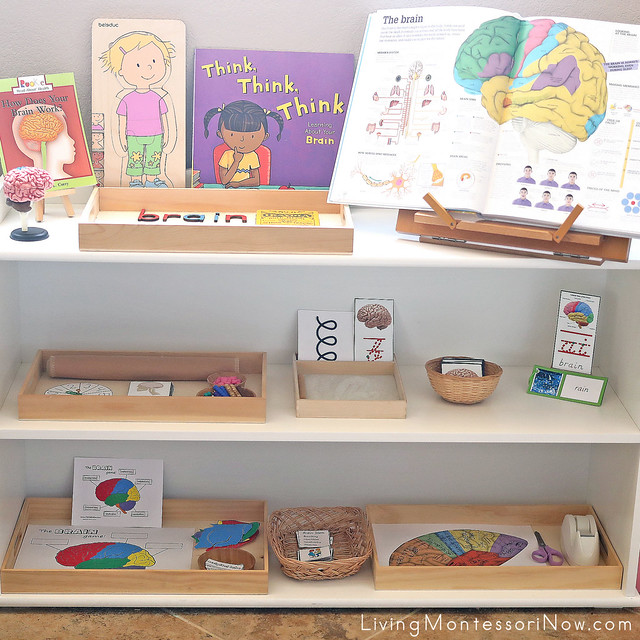
Montessori Shelves with Brain-Themed Activities

Montessori Shelves with Brain-Themed Activities  

These themed shelves have human brain-themed activities. (On another shelf, I'll have a few growth mindset activities throughout the month.) You’ll also find Montessori-inspired brain numbers, letters, and and more (part of my subscriber freebie pack, so just sign up for my email to get the link and password … or check the bottom of your latest newsletter if you’re already a subscriber) 

I always have related books available throughout a unit. I have How Does Your Brain Work?, Think, Think, Think, and Young Genius Brains in addition to lots of growth mindset books. (I'll publish a post about those at Bits of Positivity.) 

The open book on the shelf is the DK Smithsonian Picturepedia, which I love to have for a variety of themes. (It's actually for ages 8-12, but it has great pictures and lots of information that can be shared and adapted according to the interest and age of the child.) 

In addition to the brain model, I have the Hape Your Body 5-Layer Wooden Puzzle Girl on the shelf. (There’s also a boy puzzle.) This is to give a general overview of the human body and show the brain with the other organs of the body.It was interesting that a week before we started this unit, Zoey asked me to get out this specific puzzle because she loved it so much when we used it for a mini skeleton unit last fall.

You could mix your brain-themed activities among your shelves according to curriculum area. Or you could have a special brain-themed area something like the one pictured. My shelves this month have a mixture of skill levels, although most are for older preschoolers and kindergartners. Many of the activities can be adapted for a variety of levels. If you’re a homeschooler, just choose the activities that work for your child’s interests and ability levels. If you don’t have room for all the activities you’d like to do, simply rotate them.

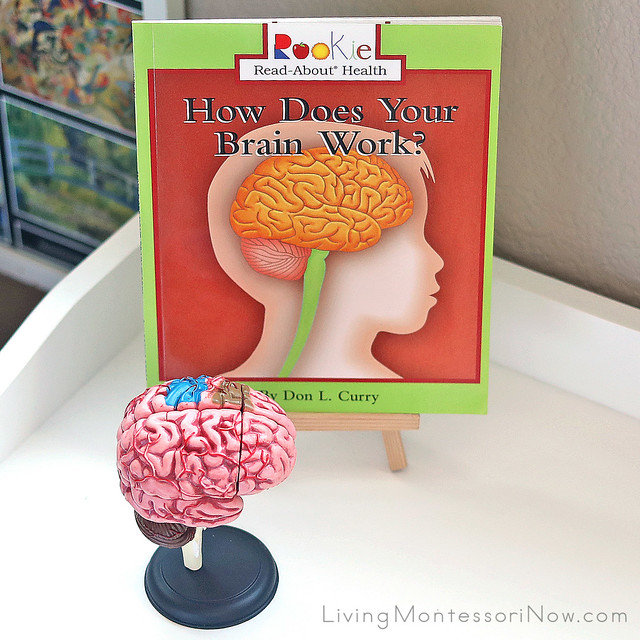
Human Brain Model with How Does Your Brain Work? Book

Human Brain Model with How Does Your Brain Work Book How Does Your Brain Work? has an amazing amount of information for such a simple book!  
I got the Learning Resources Brain Model for this unit. It seemed to be the best inexpensive brain model. It is small, but I don't have a large amount of shelf space. So the size is perfect for us. Of course, the directions for assembling it could be much better. My son-in-law put it together with my 4½-year-old granddaughter, Zoey. Zoey loves the brain model and really liked that her Uncle Tom showed her where the different brain parts were inside her own head.

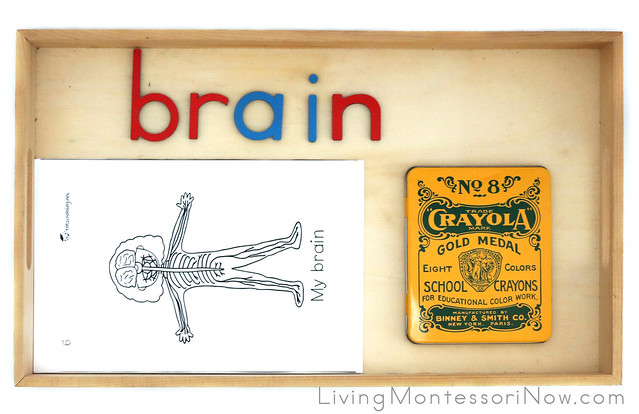
"Brain" Spelled with Movable Alphabet Letters and Brain Page for My Body Systems Book

Brain Spelled with Movable Alphabet Letters and Brain Page for My Body Systems BookFree Printable: My Body Systems Science Booklet from Totschooling 

Zoey and I often analyze words, so I spelled the word "brain" with the small wooden movable alphabet letters on the tray with the brain page for My Body Systems booklet. Zoey and I will be adding the other pages to the book, too. We'll read a bit about each body system during this unit.

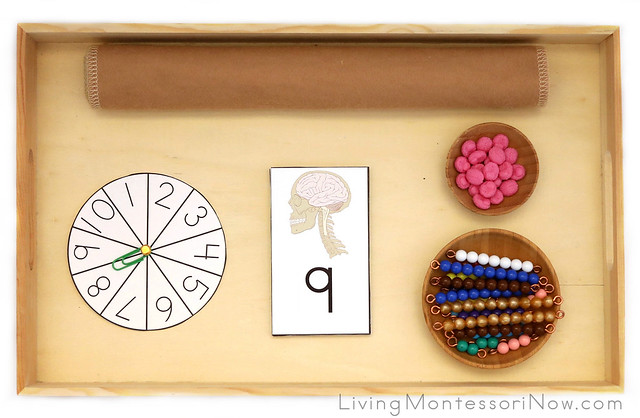
Brain Addition with Miniature Brains and Bead Bars

Tray for Brain Addition with Miniature Brains and Bead Bars Free Printables: 1-10 Spinner plus Skull and Brain Numbers (part of my subscriber freebie pack, so just sign up for my email to get the link and password … or check the bottom of your latest newsletter if you’re already a subscriber) 

This activity uses a piece of felt for a table mat (I used the Montessori Services felt table mat) and bead bars from the decanomial box in a Multicraft tray and a Bambu condiment cup (what I used here) or  Montessori Services basket. (My bead bars, which I love, are from Alison’s Montessori. You can get bead bars on Amazon, although I haven’t personally used materials from those companies.) 

Zoey is totally in love with the miniature brains from the Bag O' Brains (There are 25 brains in the bag, but I used 20 for this activity). 


 Zoey had so much fun with this addition activity! She used the spinner to choose the numbers, counted out the brains, found the matching number cards, and then placed the correct bead bars at the end. She did the activity a number of times. For a younger child, you could use the number cards for DIY cards and counters or another type of counting activity.

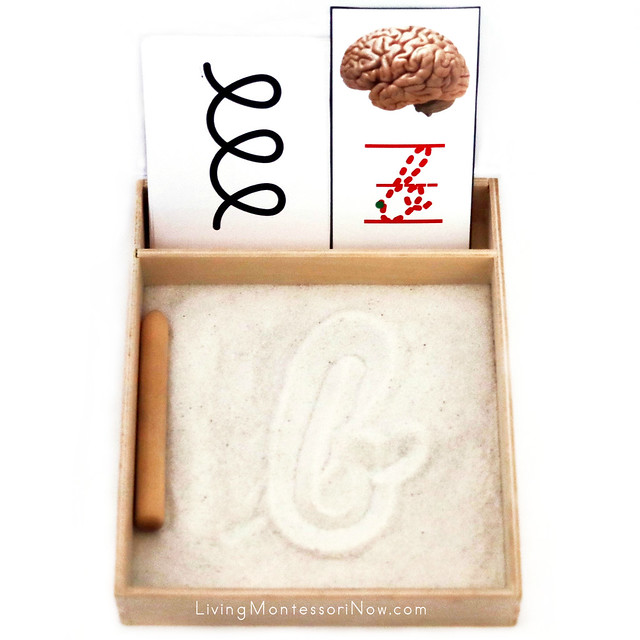
B Is for Brain Sand Writing Tray with Left and Right Brain Writing Cards

B Is for Brain Sand Writing Tray with Left and Right Brain Writing Cards Free Printable: Montessori Sand Tray Writing for Left and Right Brain from Jana (This is a cool printable and very useful for a variety of ages.) 

Free Printables: Cursive "b" brain card for constellation writing tray (part of my subscriber freebie pack, so just sign up for my email to get the link and password … or check the bottom of your latest newsletter if you’re already a subscriber) 

For the sand tray, I used the wooden tray from the Melissa & Doug Lace and Trace Shapes. You can use whatever tray or container work best for you, though. I had gotten some lovely white sand (for making kinetic sand and other projects), which works perfectly for the sand tray. 

If you would like help with introducing phonetic sounds, introducing objects with sounds, or beginning phonics in general, check out my DIY Beginning Montessori Phonics with Preschoolers.

Brain Movable Alphabet

Free Printables: Brain Movable Alphabet (part of my subscriber freebie pack, so just sign up for my email to get the link and password … or check the bottom of your latest newsletter if you’re already a subscriber) 

The brain letters can be used to match to sandpaper letters or movable alphabet letters and place letters in alphabetical order. You can also use them for traditional movable alphabet word-building work.

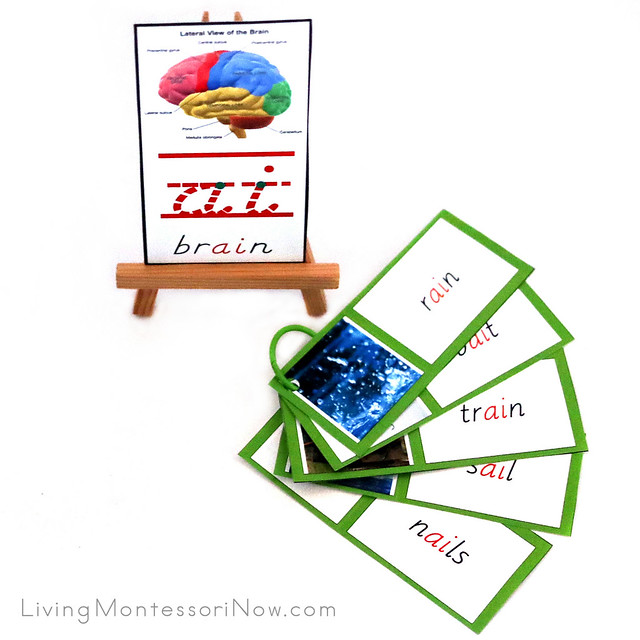
Brain ai Phonogram Card and Booklet

Brain ai Phonogram Card and Booklet Free Printables: “ai” brain font card (part of my subscriber freebie pack, so just sign up for my email to get the link and password … or check the bottom of your latest newsletter if you’re already a subscriber) 

Free Printable: Green Series ai Letters from MontessoriSoul (Print two sets if you want to use the pictures for movable alphabet word building.) 

This is so easy to prepare, yet it isolates the ai phonogram very well. 

I have a post and video on how to introduce words starting with phonograms, even with very young children.

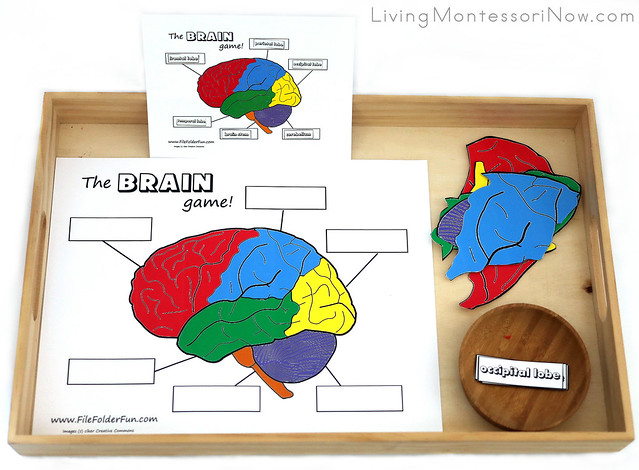
Tray with Parts of the Brain Puzzle and Identification Tray with Parts of the Brain Puzzle and Labeling

Free Printables: Brain Puzzle and Brain Center Learning Materials form The Crafty Classroom 

This was amazingly easy to prepare, yet is colorful and appealing to young children. You could have a control page for the puzzle, but I placed it on the tray so that the printed page could be the control even though it's too small for the child to build the puzzle right on it. 

For a younger child, I would have a printed control page the same size as the actual puzzle. I just printed the puzzle on cardstock, although you could always trace around the parts on felt to make a felt puzzle if you prefer. 

I printed out the page that's shown in quarter size and made a small control chart for the labeling activity.

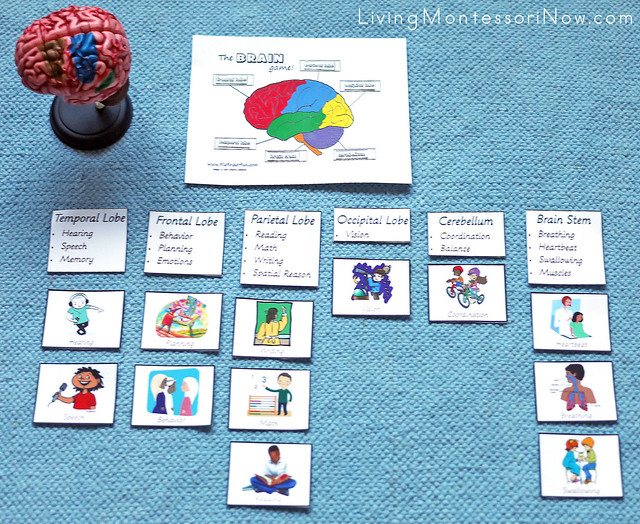
Brain Functions Activity

Brain Functions Layout

Free Printable: Brain Functions Cards from Noor Janan Homeschool 

These couldn't be easier to prepare. I simply printed and cut them out and then placed them in a Montessori Services basket. 

This is a simple way to reinforce the functions of the parts of the brain.

Making a Brain Hemisphere Hat (shown in lower right of the bottom shelf)

Free Printable: Brain Hemisphere Hat from Ellen Mchenry's Basement Workshop (This was designed for ages 10-14, but it can be adapted for a variety of ages.) 

I have this on the shelf, but I'll be doing a number of other brain activities first. This will help consolidate the knowledge from our unit.

More Free Brain and Anatomy Printables

Go to my post at Living Montessori Now for links to free brain and growth mindset printables from around the blogosphere: Free Brain and Growth Mindset Printables and Montessori-Inspired Brain Activities. And be sure to subscribe to my email list if you'd like to get an exclusive free printable each month (plus two more awesome freebies right away): Free Printables.

Growth Mindset Resources

I have lots of growth mindset resources at Bits of Positivity. I'll be adding more each week during this unit study, too.

More Anatomy Activities and Resources

If you'd like to focus on manners with children, please check out my eBook Montessori at Home or School: How to Teach Grace and Courtesy! It's written for anyone who'd like to feel comfortable teaching manners to children ages 2-12. I'm also one of the coauthors of the book Learn with Play – 150+ Activities for Year-round Fun & Learning!

Have a great start of the school year!
Deb - Siganture
Deb Chitwood
Deb Chitwood is a certified Montessori teacher with a master’s degree in Early Childhood Studies from Sheffield Hallam University in Sheffield, England. Deb taught in Montessori schools in Iowa and Arizona before becoming owner/director/teacher of her own Montessori school in South Dakota. Later, she homeschooled her two children through high school. Deb is now a Montessori writer who lives in San Diego with her husband of 43 years (and lives in the city where her kids, kids-in-law, and grandkids live). She blogs at Living Montessori Now.

Living Montessori Now Button

Sunday, July 22, 2018

Dancing from STEM to STEAM to STREAM!

Hello!

Dancing to stories is one of the main activities that young children have enjoyed in my creative movement classes over the years.  Reading a book or story, then using verbal prompts to encourage the children to relive the story through dance and music, is also a wonderful way to incorporate the all-important "A" for Arts and the "R" for Reading into STEM. 

STEM to STEAM to STREAM -- let's go!  

Recreating the story with movement helps children to understand the concepts in the book and learn about them kinesthetically.   This process also helps children identify with settings, characters, plot and themes of the story, and helps with sequencing, comprehension, and vocabulary.  Most of all, though, this activity makes story time lively and even more fun.

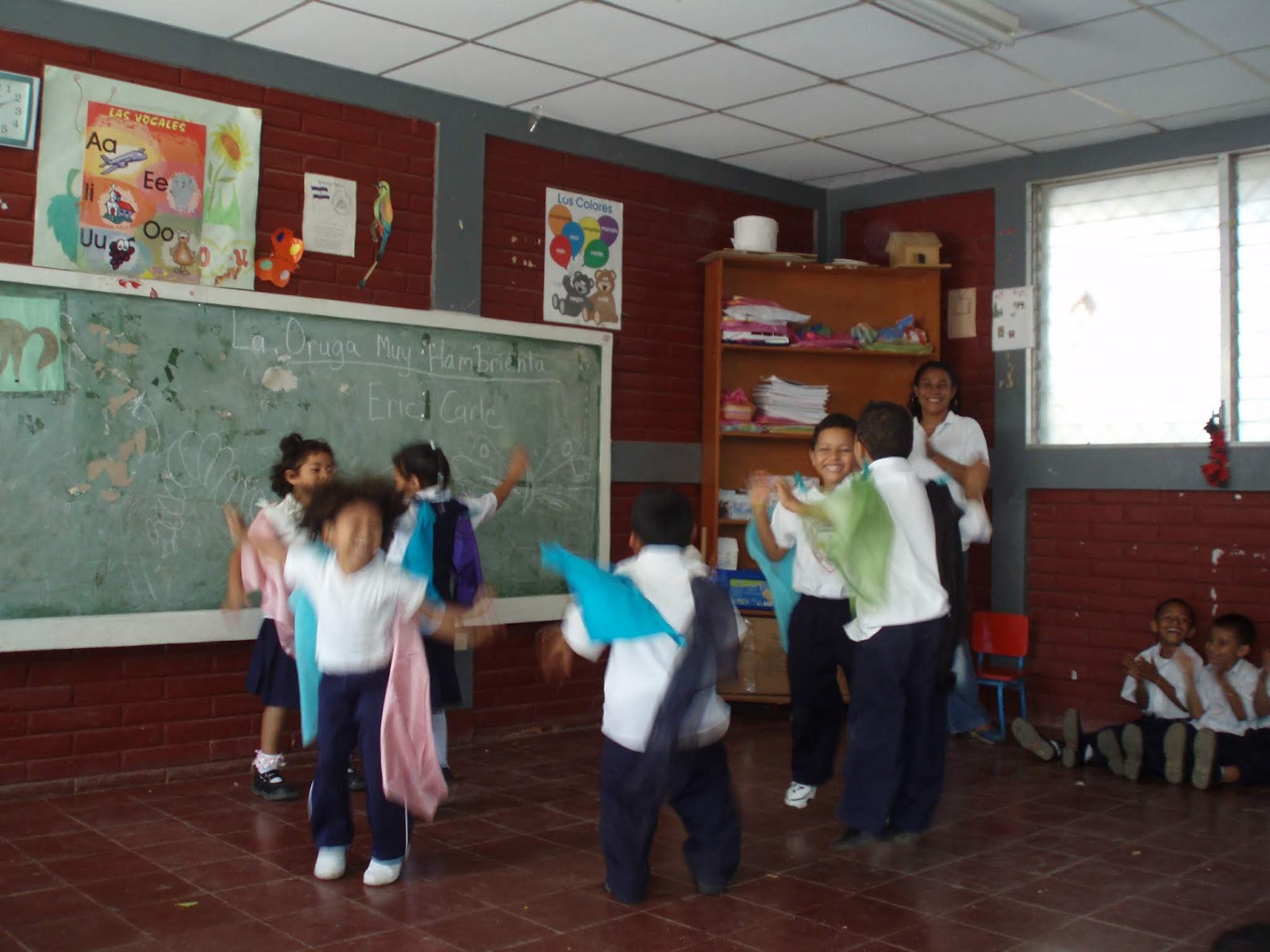
Here is a dance story that I have created based on Eric Carle's classic book The Very Hungry Caterpillar.  Along with instructions for presenting the dance story, I have included photos of a visit I made to a school in Nicaragua.  I had the Spanish version of the book, La Oruga Muy Hambrienta.  

I often supplement a dance story with props.  In this case, I used colorful scarves which become the wings when the caterpillar becomes a butterfly.  

The materials you will need for this activity are:

1.  The book The Very Hungry Caterpillar, by Eric Carle
2.  Colorful scarves or fabric scraps, about 12" square 
(2 per child)


3.  Two lively instrumental musical selections, one of which has a conga rhythm


Now you are ready to begin!  Gather the children together and read the story.


Explain the dance story, and tell the children that you will be giving them movement prompts so that they will be retelling the story with dance and music.  Make sure to give the children plenty of time to respond to each of your movement suggestions.

Play the music softly in the background.  

Begin:  

You are a little egg on a leaf, in the moonlight.


Pop out of your egg!

You are so hungry.  Where would you find some food?     Proceed through each day in the story as the caterpillar finds new things to eat.

Eat as much as you can and become a great big caterpillar!

Your tummy hurts! Eat a nice green leaf to make you feel better.

Now it is time to spin your cocoon! Turn, turn, spin, spin, spin!  Wait inside your cocoon while you make your amazing transformation.  

While the children are waiting, use a clothespin to attach a scarf to each of their shoulders.

Nibble a hole in your cocoon, and push your way out. Push hard.  Push with your feet, your wings, and look, you are a colorful butterfly! Your wings are still wet.  Try to flap them up and down, very gently.  Now, flap harder, and fly.  Fly around the room, beautiful butterflies!


Now we will finish our story by making a giant caterpillar! Form the children into a line, and put on the conga music.  

Play the conga music, stand at the front of the line and introduce the conga step:  one, two three, touch heel to one side (rhythm:  one, two, three + four), repeat to the other side, and continue all around the room.


Caterpillar Conga line.  One, two, three, and four!

Happy dancing -- 
from STEM to STEAM to STREAM!


Keep on dancin',

Connie


MOVING IS LEARNING!


Related Posts Plugin for WordPress, Blogger...