Showing posts with label hearts. Show all posts

Friday, January 16, 2015

Friendship In Action With Music!

   Miss Carole of Macaroni Soup here in chilly Chicago! After finally coming back from Winter Break and Weather Interuptus Days, I love introducing songs that promote friendship.  In February we get all lovey-dovey for Valentine’s Day – but what does that mean to a young child?  I go for the angle of being kind to our friends, caring to our families, and sharing the joy of music-making and dance.

   This month I’ll introduce you to three of my favorite songs and dances that promote sharing, caring and fun through music and movement.  
                        Here we go!

1. Who Will Be My Friend Today?
    The tune is “Here We Go ‘Round the Mulberry Bush” – hear it here.  The activity is fairly simple.  Make 2-3 hearts – they can be paper (single use) or plush or felt (multiple uses.)  My hearts are felt with a little stuffing, then hot glued around the edges.  They’ve lasted years!

THE SONG:        Who will be my friend today,
                        Friend today, friend today?
                        Who will be my friend today,
                        This bright and sunny morning?

                        You will be my friend today,
                        Friend today, friend today!
                        You will be my friend today,
                        This bright and sunny morning!

WHAT TO DO:
For Preschool:  Everyone sits together in the middle of the room (or rug, or any open space.)  The teacher gives the hearts to 2-3 children - if your group is fewer than 8 children, you may use 2 hearts, use 3 hearts for larger groups.  The children with the hearts walk around the group while everyone sings the first verse.  Then each child gives their heart to a sitting friend, taking them by the hand to walk around the circle with them as everyone sings the second verse.  The hearts are collected by the teacher, who gives them to new children.  Repeat the sequence until everyone’s had a chance to go around the circle.

For K’s:  Everyone sits together in the middle.  The teacher gives the hearts to 3 children, who walk around the group while everyone sings the first verse.  Here’s where it’s different for some groups.  If your children have become self-conscious about holding a classmate’s hand, as I occasionally find with K’s, the game becomes a hand-off – with the new carrier of the heart now going around the circle and the original carrier sitting in their place on the floor.  You may have to try it once to see how your class reacts. In this case, you would only use the first verse.

NOTE:  I ask children to only give the heart to someone who has not walked yet. “If you haven’t walked yet, raise your hand silently so that the walkers know who they can choose. Should a friend offer you a heart and you've already had a turn say 'Thank you, but I've already had a turn.'”

Jump Jim Joe!
2. Jump Jim Joe! 
    This is one of my absolute favorite partner dances!  Hear it here.  It’s a folk dance of the best tradition!  Please learn this song well enough to sing it with your students at a slow enough tempo for them to do all the dance moves.  You may never use the recorded music – I don’t!  We need the slight pauses (P) I put in at the end of each action so that everyone can do it well.
THE SONG:     
        Jump, jump, jump Jim Joe
        Nod your head (P) and shake your head (P)
        And tap your toe.
        ‘Round and ‘round and ‘round you’ll go
        Now you find another partner
        And you jump Jim Joe!

THE DANCE:    Each child faces their partner, holding hands. 
        Line 1:  They jump!
        Line 2:  Nod heads up and down - demonstrate “yes”
                    Shake head – demonstrate “no”
        Line 3: Tap toe to the side (still holding partner’s hands)
        Line 4: Two hands circle – not too fast!
        Lines 5-6: Find a new partner – someone you haven’t yet danced with!
...And tap your toe!
'Round and 'round and 'round you'll go...


 I do "Jump Jim Joe" with three year olds through school-aged children, and they LOVE IT!  Also great for mixed-age groups and parent participation events!


3. THE MUFFIN MAN DANCE!
Yes, I know the Muffin Man!
    This one is for the youngest among us – 3’s and younger.  Not that a 4 year old won’t enjoy it – it’s a great introductory partner dance – because it’s VERY simple!  Hear it here.

THE SONG:      
Oh do you know the Muffin Man,
The Muffin Man, the Muffin Man?
Do you know the Muffin Man
Who lives in Drury Lane?

Yes, I know the Muffin Man,
The Muffin Man, the Muffin Man!
Yes, I know the Muffin Man
Who lives in Drury Lane!


THE DANCE:  Help children choose partners – they’ll be keeping their partners in this one!  They hold “inside hands” so that they can walk together around the room (as they did with the hearts in our first song.)  For the first verse, couples walk hand-in-hand around the room.  For the second verse, they face each other and clap hands pattycake style.  Repeat! 


REMEMBER: Demonstrate the dance before inviting the children to stand and join in. Use another teacher OR a child to help show what to do (choose your partner wisely!)  
   There you go!  Get those dancing feet moving – especially when the weather prevents you from going outdoors!  It’s not just good for the kids, if you know what I mean…

Yours for a Song and Dance!
“Miss Carole” Stephens


Thursday, January 15, 2015

Montessori-Inspired Valentine Activities Using Free Printables

By Deb Chitwood from Living Montessori Now 

I have so many great memories of valentine activities as a Montessori teacher and homeschooler! I also have lots of fun Valentine's Day memories from when I was a child. 

So I had a great time searching for free valentine printables for this post. There are lots and lots of awesome valentine printables available, so I limited my post at Living Montessori Now to free valentine learning printables. 
 

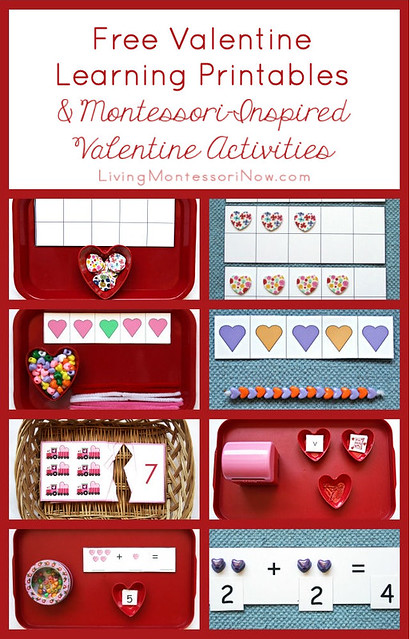
Free Valentine Learning Printables and Montessori-Inspired Valentine Activities 

I shared my list of free valentine learning printables in my post today at Living Montessori Now. Here, I've created some valentine activities using free printables for preschoolers through kindergarteners. 

You'll find many activities for preschoolers through first graders throughout the year along with presentation ideas in my previous posts at PreK + K Sharing. You'll also find ideas for using free printables to create activity trays here: How to Use Printables to Create Montessori-Inspired Activities

At Living Montessori Now, I have a post with resource links of Free Printables for Montessori Homeschools and Preschools.  

Disclosure: This post contains affiliate links at no cost to you.  

Heart Button Sorting and Counting

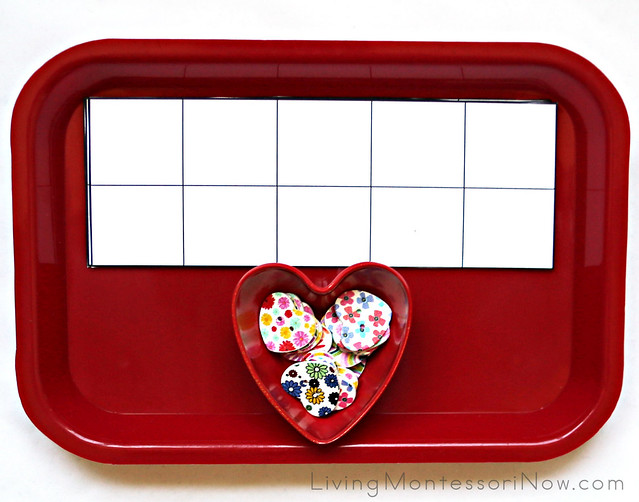
  Heart Button Sorting and Counting For this activity, I used the free Blank Ten Frames at Teachers Pay Teachers. I found these heart-shaped painted wooden buttons on Amazon. They arrived quickly and are very cute. I love the feel of them for sorting activities. They would be awesome for a Montessori-inspired sewing activity, too. 

I used a medium-size tray from Montessori Services. I found small heart-shaped bowls at my grocery store a couple of years ago, but I'm not sure if they're still available anywhere. 

The button-sorting activity is wonderful for visual discrimination skills, and I used the ten frames to add a math activity. I typically use one design or color of material for a counting activity (see "Isolation of Quality"), but I wanted to include a sorting activity to make the activity more challenging. 

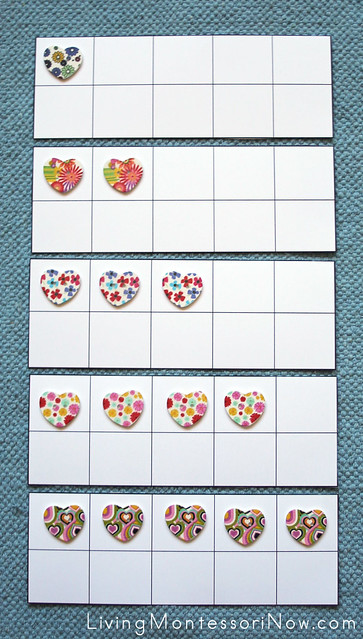
Young preschoolers could lay out the ten frames on a rug in any order. (I used a Montessori Services rug for my layout.) After the buttons are sorted on the ten frames, the child could line up the ten frames as shown below. 

Older children could focus on addition by using the ten frames to see which number could be added to the number shown buttons to get a sum of 10. 
 

Heart Button Layout  

Heart Patterning Activity 

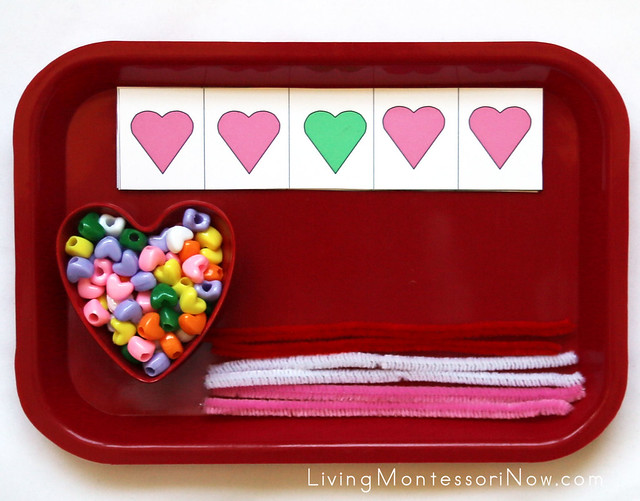
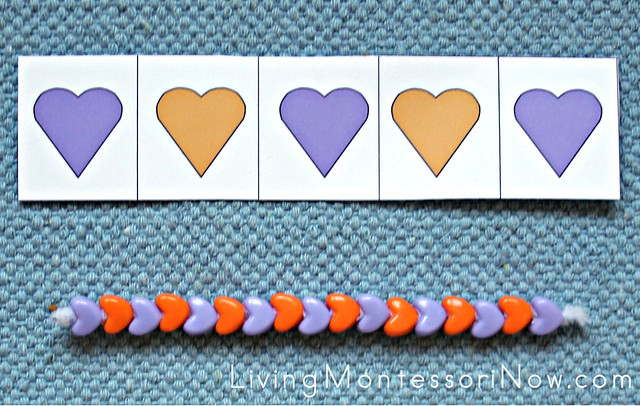
  Heart Patterning Tray This activity uses the free Heart Patterning printable by Two Preschool Gals at Teachers Pay Teachers. There are 4 different patterns. 

I used the same type of tray and bowl along with pipe cleaners cut in half and heart-shaped pony beads in the colors on the printable. 

Children could use as many beads as they wish to continue the pattern on a pipe cleaner. They could make a bracelet following the pattern, too. 
 

Heart Patterning Layout  

Valentine Transportation Count and Match Puzzles

  Transportation Valentine Count and Match Puzzles 
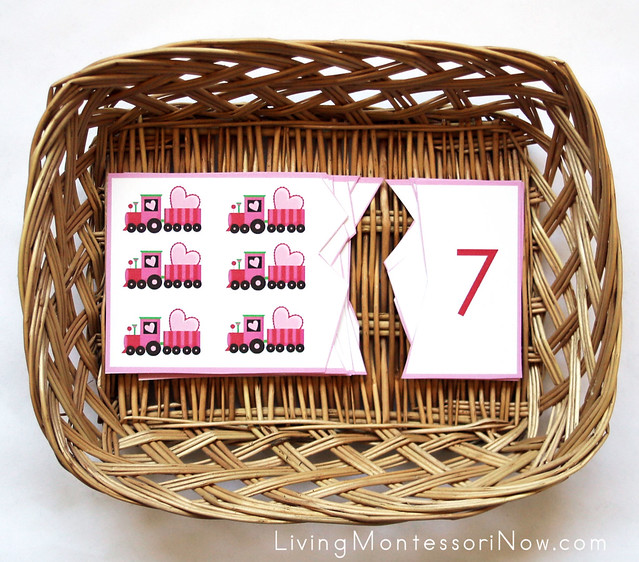
I like the printable for this activity for vehicle lovers who might not be interested in traditional heart activities. It's the Valentine Number Puzzles from I Love Trucks, a Free Valentine’s Pack for Boys by Our Little Monkeys. 

The activity was very easy to prepare. It only required printing, laminating, and cutting the puzzle pieces. I used a Montessori Services basket (the small willow basket, which is my go-to basket for many card materials). 
 
Valentine Addition 

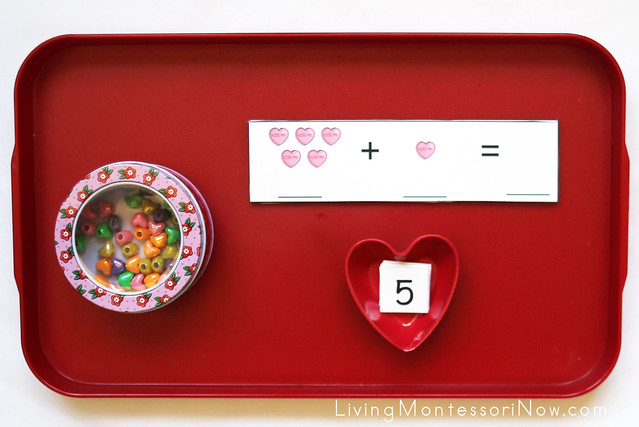
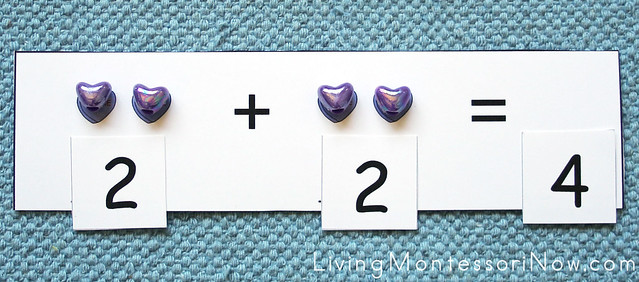
  Heart Addition Activity This activity uses the Valentine Addition printable from the Valentines Pack (part 3) by Cassie from 3 Dinosaurs along with the numbers from part 2 of the pack. 

I used iridescent heart-shaped pony beads that I thought were very pretty for this. The tray is the Montessori Services large plastic tray, which I use for many types of activities. I found the round container at a craft store a couple of years ago, so I don't know if it's still available. (Note: I really like the beads and buttons I found for these activities. They can be used for a variety of activities over a number of years.) 

You could add small tongs or tweezers for a practical life activity, although I think using fingers is great for fine-motor skills when working with the heart-shaped beads. It might detract too much from the addition work to use a tool with this activity since there are a number of addition problems in the printable. I counted out 10 of each color of bead so the child could complete any of the problems. 
 
Heart Addition Layout  

"Letter in the Mail" Beginning Sounds Activity 
  "Letter in the Mail" Beginning Sounds Activity 

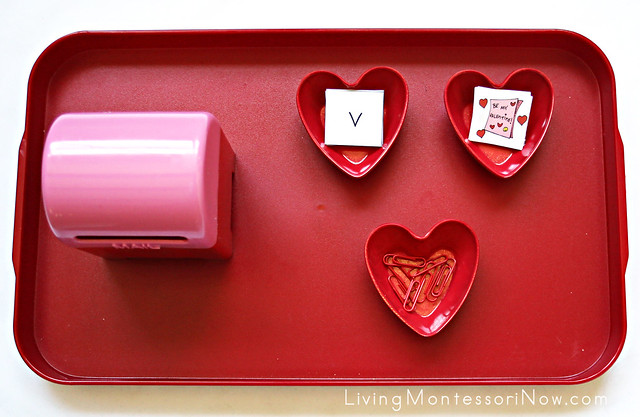
I used the "Letter in the Mail" printable from the Valentine Pre-K/K Pack {Updated and Expanded} by This Reading Mama. I cut apart the letters and pictures and added a valentine mailbox to make the activity extra appealing and hands-on. 

I think the valentine mailbox was from the Target dollar section a couple of years ago, but you could use any valentine mailbox that has a slot big enough for the cards in this activity. 

I added paper clips to the activity so the child can clip the matching picture to the letter. He or she could then "mail" the letter (letter with letter-sound picture). Continue until all the letters are mailed. 

You can learn more about introducing beginning sounds in my DIY Sandpaper Letters post

Here's the link to my favorite laminator ... inexpensive and great for almost any activity that needs to be laminated!
 
More Free Valentine Printables and Montessori-Inspired Valentine Activities

Go to my post at Living Montessori Now for links to valentine learning freebies from around the blogosphere: Free Valentine Learning Printables and Montessori-Inspired Valentine Activities.
Montessori at Home or School - How to Teach Grace and Courtesy eBookIf you'd like to focus on manners with children, please check out my eBook Montessori at Home or School: How to Teach Grace and Courtesy! It's written for anyone who'd like to feel comfortable teaching manners to children ages 2-12.

Have fun preparing for Valentine's Day!
Deb - SigantureLiving Montessori Now Button 
Deb ChitwoodDeb Chitwood is a certified Montessori teacher with a master’s degree in Early Childhood Studies from Sheffield Hallam University in Sheffield, England. Deb taught in Montessori schools in Iowa and Arizona before becoming owner/director/teacher of her own Montessori school in South Dakota. Later, she homeschooled her two children through high school. Deb is now a Montessori writer who lives in San Diego with her husband of 39 years (and lives in the city where her kids, kids-in-law, and baby granddaughter live). She blogs at Living Montessori Now.

Sunday, February 3, 2013

Emotion Regulation: The Heart of the Matter

Emotion Regulation -- The Heart of the Matter


February is, among other things, heart health month, and many early education professional spend at least the week of Valentine’s day focusing on aspect of hearts. On aspect of the heart that you may be less familiar with is vagal tone and the vagus nerve.


There are many reasons and assumptions we make regarding children’s behaviors and emotional expression. Have you ever had that kid in class who just cried about everything? Or who never seemed to get upset? What about adults in your lives? Or yourself? Are you the emotional roller coaster? Or are you the rock steady person?

If we really step back and think about the psychology and physiology behind emotion regulation, we can start to understand the mechanisms that determine individual differences in the expression and regulation of emotion. One lesser kown aspect of this process involves the heart….and the nerve that regulates many aspects of heart function.

Vagal tone is determined by the activity of the vagus nerve. The vagus nerve is a cranial nerve (10th) in the brainstem. Its impulses regulate various aspects of heart function including heart rate. In the seminal article written in 1994, Porges, Dooussard-Roosevelt, & Maiti explored the link between vagal tone and emotion regulation. “Vagal tone is a physiological index of parasympathetic nervous system influence on the heart that has predicted a number of emotional behaviors and styles in infants, children, and adults” (Movius & Allen, 2005).

The vagus is a complicated system that is categorized as part of the parasympathetic nervous system. The vagus nerve controls the S-A node which is the “primary pacemaker of the heart.” When the S-A node is stimulated by the vagal system, heart rate is slowed. When the vagal system is not stimulating the S-A node, heart rate speeds up. The vagus nerve mediates heart-rate changes. This is especially apparent during fight-or-flight situations when there are rapid changes to heart rate due to emotional states.


In other words, vagal control/tone of heart rate is key to helping people with approach-withdrawal situations. When we attend to social cues and determine psychologically whether to approach or withdraw from (fight or flight) situations. Studies have shown that people who have “higher vagal tone” are better able to regulate their emotions when under stress and are less distracted and pay more attention to new inputs. Research has also shown that people with higher vagal tone appear to express more facial expressions of emotion and have a greater range and instances of emotional expressiveness as well as experience less negative emotionality.  People with lower vagal tone are less able to regulate their responsiveness to stress and often present as anxious and defensive when under stress. Low vagal tone people have fewer coping mechanisms and take longer to calm down after an emotional episode.


 The next time you are wondering why a child is unable to control his/her emotions or seems to always “over react,” consider that the child might be “hard-wired” via the parasympathetic nervous system to react or under-regulate. Knowing that this is a possibility may help early care and education professional better react and relate to these types of children. When we understand that there may be an underlying physiological reason for certain behaviors (reactivity, anxiety, defensiveness, difficulty calming down, low attention spans, etc.), we can better respond to those children and strengthen our relationships with them.


h


References:
Movius, H. L. & Allen, J. J. B. (2005). Cardiac Vagal Tone, defensiveness, and motivational style. Biological Psychology 68, 147-162. Available online at www.sciencedirect.com.

Porges, S. W., Doussard-Rooevelt, J. A., & Maiti, A. K. (1994). Vagal Tone and the Physiological Regulation of Emotion. Monographs of the Society for Research in Child Development, 167 – 188. 


Dr. Ellaine B. Miller, PhD, is the Managing Director for the Family Child Care Partnerships program at Auburn University. www.humsci.auburn.edu/fccp


Related Posts Plugin for WordPress, Blogger...