Showing posts with label positive behavior. Show all posts

Friday, July 29, 2016

Challenging Behavior in Preschool


What IS challenging behavior?  And is it our issue?  A child's behavior "problem"?  And, what's a teacher to do?

When I attended the NAEYC Conference in Florida this past November, I took part in a research project that Yale University was working on.  

It was, in part, to study how teachers identify challenging behavior.  There was a written survey with several preschool behavior scenarios to respond to.  There was also a computer-based portion of the survey.

During the computer based portion, I was given a hand held device with a button on it and was instructed to watch a few video scenarios of preschoolers at play and to press the button any time I saw what I considered a challenging behavior take place.

The computer program they used actually tracked my eye movement so they could track and identify what portion of the video was playing when I presssed the button (sounds pretty sci-fi-ish!  ;) )

During the video portion (which took approximately 10 minutes), I only pressed the button once.  In speaking with other teachers who participated, some shared that they pressed the button once or twice where others said the pressed it far more times than that.

For example, in one scene 3 children were playing with toy cars at a table having a grand ole time.  And then, one child took the car from another child.

My hand was hovering over that button, but I didn't press it yet.  I wanted to see how the other child responded first.  She just looked at the "taker", then looked at the other child, then shrugged her shoulders and kept playing with what she had.  The other child then gave her one of his cars.  The taker continued playing.

I never pressed the button.  Two other teachers said they did not either.  Three other teachers said they did.  

This got us all thinking about how differently we all are when labeling behavior as challenging.  

Sometimes we insert ourselves into situations with children that do not need our help. Sometimes we let things go that we should have interceded in.  It can be a fine balance of knowing when to step in and when to let the situation unfold.

The scenario in the video I watched was a pretty benign one.  

However, we have all experience the above scenario where the result was wildly different!  One in which the result was the "takee" getting upset and crying, screaming or hitting the "taker".  One in which the "taker" either yelled back, laughed or even cried because he/she doesn't understand why they could not play with that car!

NOW who do you help first?? And how?  And which child is in the wrong?

A lot of how we respond to this will depend on how we define challenging behaviors.  In this later example and in the one in the video I watched, we all might react differently. And many times that is because of what we think needs to be controlled and needs attention.

We need to approach every challenge as an opportunity to teach problem solving skills. Children can not learn to negotiate problems if they are not allowed to have them.  As for how we react--Steve Gross M.S.W. said:

"...You can't spread what you don't have.  So the first person you need to learn how to control is yourself.  And actually that's the only person that you need to learn how to control..."  Why?  He explains that "...jumping to a reaction--it's like throwing gasoline on a fire."  

Wow!  Yes!  We've all felt like this.  One teacher actually emailed me using a similar analogy--that she feels like she spends all day running around, putting out behavior fires!

So, again:  What's a teacher to do?
I have a video (with no science-fiction like eye movement tracking involved! ;) ) and a an article to share with you that are all specifically about challenging preschool behavior.


1.  A link to a video from ChildCareExchange that helps us look at our role and how we look at, and react to, challenging behavior.  It is an awesome (under 10 minute) video that you really need to watch!

2.  Information on de-escalating challenging behaviors based on The Pyramid Model.

3.  A link to an article that covers the 4 steps to proper behavior guidance.

Get your favorite beverage and check those articles and the ChildCare Exchange Video Out!  You'll be glad you did!

Do you have resources you can share with us about challenging preschool behavior?  Put them in the comments below!
About the author
Cheryl Hatch has taught and directed preschool programs for over 20 years.  She is the Creator and Owner of Preschool Plan It, a website dedicated to sharing preschool themes, activities, articles and training with early childhood educators.  She volunteers as the coordinator and teacher of the MOPPETS program in her town (a preschool program for the M.O.P.S.--Mothers of Preschoolers Program).  She has her undergraduate degree in Early Childhood Education.  Cheryl has been an active, integral member and leader within the Teachers.Net Early Childhood community for many years, moderating live chats and providing peer support on the Preschool Teachers Chatboard.  You can read Cheryl’s articles, activities and themed preschool lesson plans at www.preschool-plan-it.com 

Monday, February 17, 2014

Rewarding Good Behavior


 Do you celebrate or reward good behavior?  If so, how do you celebrate or reward it? 

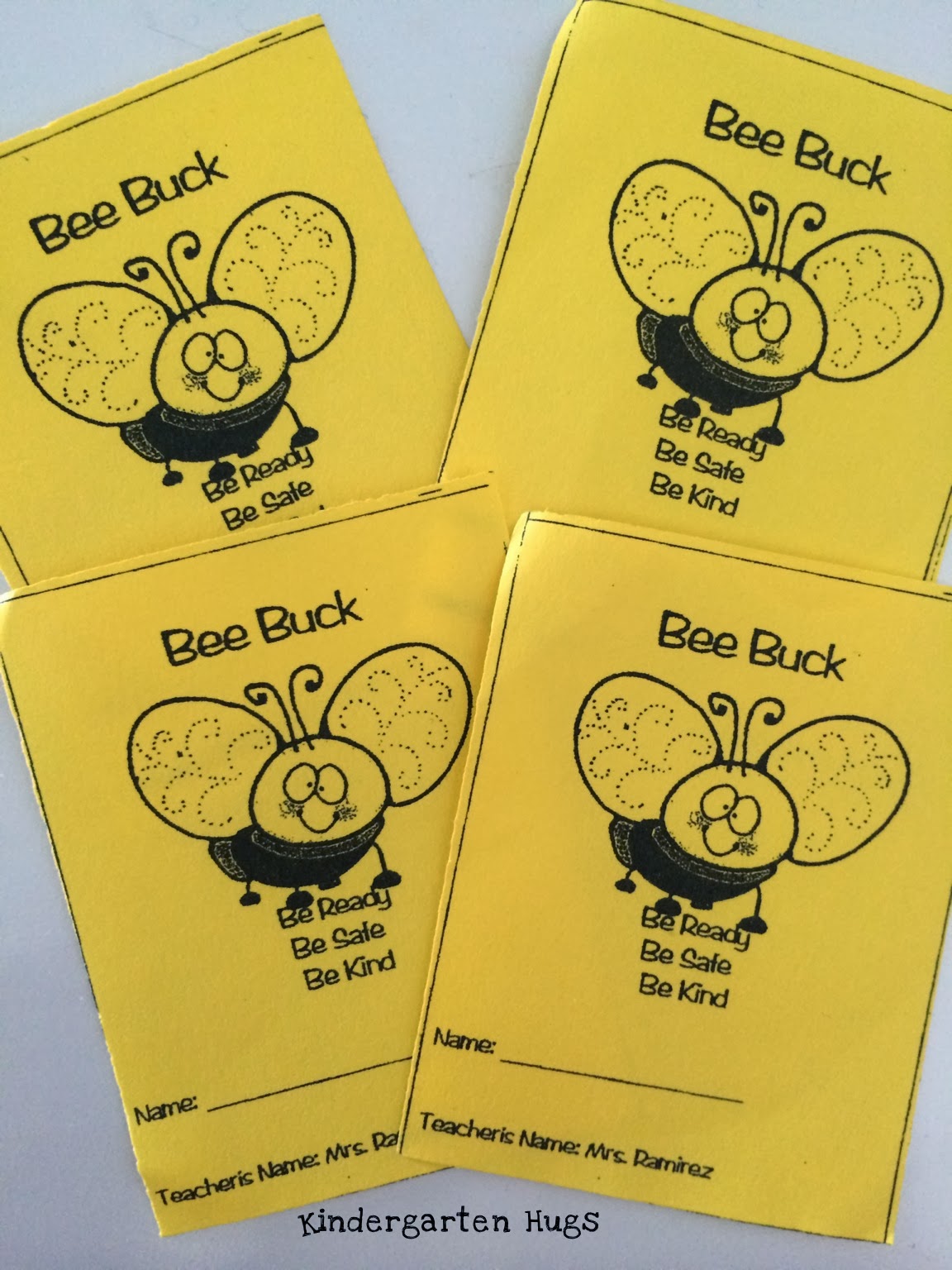
At our school, we have Bee theme behavior system. PBIS is still running strong and so we have kept our school rules short and sweet. They are, Be Ready, Be Safe and Be Kind...thus the Bee theme. When students are caught following these rules without needing reminders, they earn a Bee Buck. A Bee buck is a little ticket that has our three school rules on it, a picture of a Bee and a place for the students’ name. 


At the beginning of the year, in my classroom, when kiddos earn a Bee buck, they will write their name on it and put it in the Bee Buck can. Kiddos also get to move their name up on our behavior chart if they earn a Bee Buck. At the end of each week, I pick a name from the can to be our Bee Buck Winner for the week. Their name is also read during morning announcements with the other Bee Buck winners from other classrooms.
After Christmas, students can still earn Bee Bucks but they must collect 10 Bee Bucks to be able to put them in the special can. Once they get 10I count them, they kiddo’s put them in the can and then they get to choose a prize from my classroom treasure box.

At the end of each day, if students have been able to move their names up and they have stayed above green, they earn an m&m for each color above green they are. This is something they work VERY hard for! Students also color in their calendar for the day, so their parent’s know what color they were on for the day. I use these calendars from Lori Rosenberg over at Teaching With Love and Laughter. She has many wonderful things in her store! Check her out!! Just click on the calendar below! The clip chart is also the clip chart that I used in my classroom. 
The colors are as follows: Outstanding-Pink, Great Job-Purple, Good Day-Blue, Ready to Learn-Green, Think About It-Yellow, Teacher's choice-orange, Parent Contact-Red. Students can move up and down the chart all day long based on the choices they are making.


 http://www.teacherspayteachers.com/Product/Clip-Chart-Take-Home-Calendars-for-2013-2014-643962

I also reward overall classroom behavior. I have a tally system. When my overall class is making a good choice (working quietly, waiting quietly, walking quietly in a lineetc), they earn a tally mark. If they are not making good choices as a class, I earn a point. When students get to 10 tally marks, they earn popcorn and a movie. If I get to 10 tally marks first, students owe me work time instead of choice/play time.
We have Bee trophies for classrooms that our principal catches Being Ready, Being Safe or Being kind throughout the week. The classroom winners are also announced during Friday announcements. Then our principal presents the winning classes with the trophy after announcements. I am proud to say that OUR CLASS WON THIS PAST WEEK!!!! YAAAAAHHHHH HOOOOOOO!!! We have been working so hardand that hard work finally paid off!

 As you notice, our Bee trophy is decked out in glasses, a vest, skirt and even a purse! Each time a classroom win's the trophy, they add something special to the trophy. You may even notice that one class added a band-aide to her little leg. What should we add???


How do you reward good behavior? Leave a comment and share how you manage your classroom/child behavior! 


 Carie is a kindergarten teacher from Illinois who writes on the 17th of each month. She shares her experiences and ideas from her classroom, reading, writing, math, Art, and several other fun and exciting things!
Carie also writes her own blog: 

88
Related Posts Plugin for WordPress, Blogger...