Thursday, April 16, 2015

SPLASH! Celebrate Spring Singing!

   Hi! It’s Miss Carole of Macaroni Soup – and here in Chicago we’ve had a long, cold Winter.  I’m jumping for joy for the flowers popping up in my yard (see below) and being able to run around without a down coat, mittens, boots, a scarf and 2 layers underneath!  How about you? 
                                 Ready to Celebrate Spring?

Rain is falling down....
    Though we’ve had terrible tornados recently, we’ve also had lots of gentle rains to coax the grass and flowers along and give our big trees a much-needed drink. In my classes we are singing and dancing our favorite rain songs – and here they are!  I’ve also included info about instruments that make the sound of the rain AND a link to my “How to Make a Rainstick” blog!  Here we go!

         SPLASH! 
SPLASH!
    Hear it HERE, and it’s on my “Sticky Bubble Gum” cd.

Lyrics:
Rain is falling down, SPLASH! 
Falling to the ground, SPLASH!
Pitter patter, pitter patter
Rain is falling down, 
SPLASH!

   This is about as easy and FUN as it gets – my 1 year olds love it – but so do my 4’s and 5’s!


What to do:
    Start out sitting tall on your knees, arms stretched up high (top picture.) Wiggle
Pitter patter, Pitter patter!
your fingers as they descend to about chest level, then slap the floor on “SPLASH!”  Repeat. Wave wiggly fingers overhead for the pitter-patters, then repeat the first sequence.
    For Toddlers – 3’s, repeat several times until the “splash” is in unison.  With older children, vary the volume – loud, softer, softest, no sound, just motion.


SINGING IN THE RAIN
Original lyrics by Arthur Freed, melody by Nacio Herb Brown c.1929

    Hear it HERE, and it’s on my “Dancing Feet” cd.

Thumbs up, shoulders back, knees together!
Chorus (all sing):
I’m singing in the rain,
Just singing in the rain!
What a glo-ri-ous feeling,
I’m happy again!
Teacher:  Thumbs up!  (kids echo)
                Shoulders back!   (echo)
                Knees together!   (echo)
ALL:  Choo-choo, cha-cha, 
         Choo-choo, cha-cha
          Choo-choo, cha-cha!
   Repeat Chorus, adding a new move to the list each time:
                Bottoms-up!
                 Tongue out!
                 Eyes closed.
What to do:
     This is an echo song – explain first to the children that “whatever I say and do – you say and do it after me!  Let’s practice:  thumbs up! (echo) shoulders back! (echo)”.
     Demonstrate the chugging motion as you turn in a circle for choo-choo, cha-cha.  Then you are ready to start!  Stand up!  Hands overhead, swaying side to side while singing the chorus.

Tired of Tooty-Ta?  Add this one to your repertoire!  It’s a winner!
Choo-choo, cha-cha!

    My 4’s and 5’s class has always made rainsticks to go with this song – we make tip them back and forth during the chorus, putting them down quickly to do the echo/movement parts!  It’s hectic and quick – but fun!

  It encourages children to move,                sing AND listen!

Check out my May 2012 PreKandKblog for details on how to make excellent rainsticks that will last for years!

Want more rainy songs?  Try these:

April 2012  "Rain, Rain Go Away" and "I’m a Little Seed"
June 2014  "Ducks Like Rain"
   You may find even more rainy songs on my website’s Song of the Month archive! 

There’s also the adorable “Jump in the Puddles”, rhythm-based “The Raindrops are Falling” and “It Ain’t Gonna Rain No More”, all on my “Season Sings” cd!

Large rainstick from Chile!
    I recently brought many of the instruments in my “zoo” that make the sound of the rain for my students to listen to and play.  Pictured below: rainsticks (Chile), pacay (Peru), shekere (Nigeria), finger cymbals (orchestra), antelope toenail shaker (Africa), spice nut shaker (Indonesia), pellet drum (Mexico), coqui (Puerto Rico) and ThunderTube (Costa Rica).  What fun we had hearing all the rainy sounds!


Planning a Professional Development Workshop or Conference for Fall? Need a Keynote for 2016? Call Carole: 847-384-1404.

Yours for a Rainy Song!
Carole Stephens
Macaroni Soup! Active Music for Kids!  


(left) - from my garden.  Thank you, rain!  

Wednesday, April 15, 2015

Montessori-Inspired Water Cycle Activities Using Free Printables

By Deb Chitwood from Living Montessori Now  Today, I'm focusing on printables and activities that make learning the water cycle easier and more memorable.

Free Water Cycle Printables and Montessori-Inspired Water Cycle Activities 

I shared a list of free water cycle printables in my post today at Living Montessori Now. Here, I'm sharing some Montessori-inspired water cycle activities using free printables for preschoolers through first graders. 

You'll find many activities for preschoolers through first graders throughout the year along with presentation ideas in my previous posts at PreK + K Sharing. You'll also find ideas for using free printables to create activity trays here: How to Use Printables to Create Montessori-Inspired Activities. 

At Living Montessori Now, I have a post with resource links of Free Printables for Montessori Homeschools and Preschools. 

Disclosure: This post contains affiliate links at no cost to you. 

R is for Rain Pom Pom Transfer 

r is for rain Pom Pom Transfer 

For this activity, I used the free r is for rain Magnet Page from Making Learning Fun. The tray for this activity is a Multicraft tray with a Montessori Services basket. I added a toast tong for a practical life component and pom poms for the transferring and phonics activity. 

For the "r" is for rain part, I always emphasize the phonetic sound (/r/ for rain) rather than the letter name. I like that this printable uses the lowercase "r," which is consistent with the way letters are introduced in Montessori education.

Exploring and Transferring Pom Poms at 17 Months 

My 17-month-old granddaughter is getting past the mouthing stage, so I allowed her to work with the activity (with supervision, of course). I showed her how to put the cotton balls on the cloud circles and then let her use her hands to transfer them from the basket to the cloud. She spent some time exploring the texture of the cotton balls, and she also enjoyed transferring the cotton balls. 

Water Cycle Songs and Poems 


This activity uses the free Water Cycle Song Handout (tune: “She’ll Be Coming Aound the Mountain”) by Jaya Maharajh at Teachers Pay Teachers, Water Cycle Song (tune: “The Wheels on the Bus”) by Susan Barr at Teachers Pay Teachers, and Water Cycle Poems by LR Teach at Teachers Pay Teachers. I added the printables to a tabletop easel I would place on a shelf with the other water cycle activities. Children who can read can use the printables to learn the songs and poems.

Water Cycle Bracelet

Water Cycle BraceletTray 

This activity uses Water Cycle Beaded Bracelet (good for younger preschoolers) from Making Learning Fun and Water Cycle Bracelet Project (good for advanced preschoolers and kindergarteners) from Mrs. Kimbrell’s Kindergarten. I added the printables for both levels along with colored beads in small containers and pipe cleaners to string the beads on. 

Making a water cycle bracelet is a great way to reinforce the water cycle. Children can string more than one set of beads, since the water cycle is continuous.


The Water Cycle Puzzle or Cut and Paste Activity

The Water Cycle Puzzle or Cut and Paste Activity 

For this activity, I used The Water Cycle Chart and Activity by Meaghan Kimbrell from Mrs. Kimbrell’s Kindergarten (blog post). This part of the printable can be used more like a puzzle. It can also be used as a cut-and-paste activity.

Water Cycle Dominoes

Water Cycle Dominoes 


This activity uses the free Water Cycle Dominoes by Erin Bittman at Teachers Pay Teachers. This is an advanced activity that's best for first graders or advanced kindergarteners. I loved the activity and had fun laying out the dominoes. It's a great way for children to reinforce knowledge learned in a water cycle unit study.

Here's the link to my favorite laminator ... inexpensive and great for almost any activity that needs to be laminated!

More Free Water Cycle Printables and Montessori-Inspired Water Cycle Activities

Go to my post at Living Montessori Now for links to water cycle freebies from around the blogosphere: Free Water Cycle Printables and Montessori-Inspired Water Cycle Activities.

You'll find lots of Montessori-inspired water cycle activities and ideas in these Living Montessori Now posts:
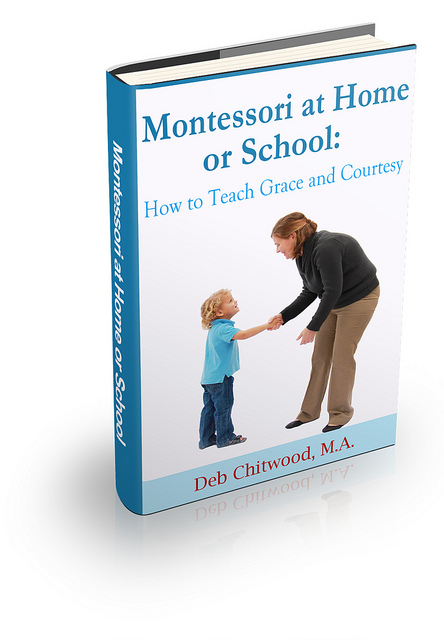
Montessori at Home or School - How to Teach Grace and Courtesy eBookIf you'd like to focus on manners with children, please check out my eBook Montessori at Home or School: How to Teach Grace and Courtesy! It's written for anyone who'd like to feel comfortable teaching manners to children ages 2-12.

Happy spring and Earth Day!

Deb - SigantureLiving Montessori Now Button 

Deb ChitwoodDeb Chitwood is a certified Montessori teacher with a master’s degree in Early Childhood Studies from Sheffield Hallam University in Sheffield, England. Deb taught in Montessori schools in Iowa and Arizona before becoming owner/director/teacher of her own Montessori school in South Dakota. Later, she homeschooled her two children through high school. Deb is now a Montessori writer who lives in San Diego with her husband of 39 years (and lives in the city where her kids, kids-in-law, and toddler granddaughter live). She blogs at Living Montessori Now.

Monday, April 13, 2015

10 Things To Do With Children Who Don’t Take Disappointment Well

Eight year old David is playing a board game with his sister. Everything is going along well until the girl wins. David gets mad and a meltdown ensues. In another common scenario, five year old Sarah is watching a cartoon on her mother’s iPad. Mom tells Sarah that it’s time to leave and she shuts off the iPad. Sarah throws herself on the floor and begins screaming.

Before I go further with this problem, please take note that this or any of my other articles are not substitutes for family therapy. They contain basic parenting advice for common situations. If your child is demonstrating serious challenging behaviors it is always a good idea to seek out the advice of a behavior health professional. Start with your child’s pediatrician to determine appropriate next steps.

From toddler to school age, the kind of behavior I described in the first paragraph can drive parents nuts. Their first response is often scolding, sympathy, or even lecturing. I’ve seen many parents go right to the child and begin rationalizing with them that their response to the loss or the end of an activity was unnecessary and over the top. The parents mean well as they try to reason with the upset child that it’s “no big deal,” or that there will be a next time.

But trying to change a child’s perspective in the heat of the moment while they are experiencing intense emotion is usually a waste of time. What’s most important in that moment is (1.) for you to remain calm and quiet, (2.) sooth or comfort the child if you can, and (3.) keep them safe from harm caused by the physical aspect of their outburst. The better time to reason with a child is (4.) after the emotion has subsided and they can actually hear you and think clearly.

The actual causes of this kind of behavior could be many. From personality trait, temperament, a lack of parental boundaries, or even physiological influences such as hunger and fatigue. It could also be just a phase the child is going through at the moment. The most important thing you can do as a parent is (5.) to learn the patterns of when this sort of behavior occurs. Take note of what the activity was, the time of day, and any events just prior to the explosive-like behavior. Keeping a (6.) journal will help if you decide to seek help from a therapist or counselor.

Use this information to (7.) plan your child’s activities to minimize the outbursts. Stay one step ahead of them by (8.) setting up clear boundaries for your child with visual limitations on play. (9.) Invite your child to help you determine how long an activity will occur and plan out transitions between activities by including your child in the planning stages. Visual timers and schedules work well because your child can see who much time is left before transition occurs, or they can see the activities that will be taking place.

Finally, (10.) provide encouragement when your child does not get angry at an outcome. Bring their attention to how well they transitioned and ask them open-ended questions that lead them to their own conclusion about how things turned out.

Bill Corbett has a degree in clinical psychology and has been invited to deliver the keynote address at a large education conference in Holland this Fall.  He is happily married with three grown children, three grandchildren, and three step children and resides in Enfield, CT.  You can visit his Web site www.CooperativeKids.com for further information and parenting advice.

Tuesday, April 7, 2015

From Caterpillar to Butterfly: An Amazing Transformation!


Hello again, it's Ayn from little illuminations! Spring is here and it is the time for new life. Everywhere I look, flowers are beginning to bloom---especially right now, here in Augusta, Georgia where the Master's Golf Tournament is about to begin. Our city is filled with blooming azaleas. The pollen count is out of control already. Just a few days ago, we celebrated Easter, the time of year associated with new life. As part of our Easter celebration , we released butterflies that we watched grow and transform from caterpillars in Sunday School. 
      ***This post contains affiliate links for your convenience. Little Illuminations is a participant in the Amazon Services LLC Associates Program.***


First, we observed the caterpillars,

photo by Kristy Zgol

Then they wrapped themselves up in a chrysalis,

photo by Kristy Zgol

Soon, butterflies emerged!

photo by Kristy Zgol

Soon we had a butterfly pavilion filled with beautiful butterflies!


On Easter Sunday, we released them in the garden. They were so comfortable in their habitat,  that several had to be lifted out--they didn't want to leave! 


They kept coming back and landing on our hands to visit! 


In Pre-K, we will be learning about this transformation next week right after Spring Break. We often make life cycle models with pasta. Here are a few examples from past years:


I usually put one of these tissue paper butterflies in my art center and wait to see what the kids do. Often, I get lots of tissue paper butterflies to decorate the room with!


My favorite books about the butterfly life cycle:


Thanks for stopping by!!!! 


**This post contains Amazon Affiliate links.  little illuminations is a participant in the Amazon Srvices LLC Associates Program, an affliate advertising program designed to provide a means for sites to earn advertising fees by advertising and linking to Amazon.com. **

I'm thrilled to say I have been blogging here on PreK+K Sharing since the very beginning!  I am a Ga. Pre-K teacher, serving 4 and 5 year olds in an inclusive setting. Stop by and visit me anytime at littleilluminations.blogspot.com where I share my PreK classroom adventures or visit the little illuminations fanpage on facebook! And be sure to check out PreK+K Sharing EEE!

Monday, April 6, 2015

Frogs and LOTS of FREEBIES!

Hi! I'm Carolyn from Kindergarten: Holding Hands and Sticking Together. I'm ready for spring  and ready for FROGS!  Today I'd like to share some favorite frog books and activities with you- plus some great TPT freebies that I've found!

Here are some of my favorite frog books:


This is my newest frog story acquisition, and I love it!

Here is a description from Amazon and a book trailer!

Fans of Mo Willems’s Don’t Let the Pigeon Drive the Bus! and Jon Klassen’s I Want My Hat Back will love meeting this willful young frog with a serious identity crisis. Frog wants to be anything but a slimy, wet frog. A cat, perhaps. Or a rabbit. An owl? But when a hungry wolf arrives—a wolf who HATES eating frogs—our hero decides that maybe being himself isn’t so bad after all. In this very silly story with a sly message, told in hilarious dialogue between a feisty young frog and his heard-it-all-before father, young readers will identify with little Frog’s desire to be something different, while laughing along at his stubborn yet endearing schemes to prove himself right.

And some pictures!


This book lends itself to so many writing activities: Why didn't Frog want to be a frog? Of all the animals Frog wanted to be, what one might you want to be and why? Would you want to be a frog? Why? and on and on...
We just finished writing our How To books and are beginning our Informational Writing. Dan Colquhoun (Rocking Dan Teaching Man) is teaching 4th grade this year. His class wrote a "How To" song about making a paper frog. I thought it would be so much fun for my kids to follow the directions and make their own! They loved it.


The first time through, we listened and danced. As the children made their frogs, I stopped the song as we completed each step. When we were done, we listened again (and danced with our new frog friends!)

This was so wonderful for my class because they got to see "How To" in action!

Many thanks to Dan and his class for the great song and activity!


SO much personality!

Of COURSE a favorite song we always have is Debbie Clement's Pollywog! (This is on my free Frog and Toad Prezi that you can get below!)


Here is another cute song for the life cycle of a frog by Harry Kindergarten. (It's on my Prezi, too.)


And you just HAVE to dance to this one... You HAVE to.  It is one of our all time favorite brain breaks!


I adore the Frog and Toad books, too. These books are just right for K-1st grade read alouds, because they transition from the primary picture books to more text, but yet have a simple enough story for the children to love- sprinkled with some humor that the children actually get. The children seem to love the relationship between Frog and Toad, too, which is fun because they want to see what the next adventure will be with these two!


I posted all about ideas to go with Frog and Toad are Friends HERE.  I shared  the ideas and activities that I use for each story in the book- LOTS of ideas.


I posted the ideas I use for Frog and Toad Together HERE. Again, I shared ideas and activities that I use for each story!


I updated my Frog and Toad Prezi to be sure it included all of the videos from these book. I update my Prezis all the time because new videos and links are available all the time. It's FREE at my TPT store if you would like it. It includes the videos to go with the book, games and activities, a short biography of Arnold Lobel, as well as lots of links to help teach the science of frogs and toads.
Just click on the picture below if you would like a copy!


I also found some really wonderful TPT freebies about frogs to share with you.  


It's always fun to have lots of choices of activities to pick and choose from.  Some years you may be in the mood for one thing, and then the next year you might decided to try something else.  That's what makes our jobs so much fun. These are some of my favorites. Here we go!

Look at this cute Lily Pad Cutting pre-writing activity from Oodles of Fun. This would make a great center even now for lots of my students, just to practice cutting!

Lily Pad Cutting (prewriting activity)
This is a fun Frog Long and Short Vowel Sort by Differentiation Station Creations.
FREE!! Frog and Toad: Sort Long and Short Vowel Words

This Frog Resource Unit (Over 140 Pages!) by The Notebooking Nook is amazing!
FREE Frogs Resource Unit and Notebooking Pages *Over 140 Pages*


Little Miss Kindergarten has a great Frog Freebie!

Frog Freebies!

Amy Maendel shared this Frog Lifecycle Freebie.

Frog Life Cycle in English

Nicole Hernandez shared these sequencing cards at her store.  They're so bright and happy!
Life Cycle of a Frog Freebie
This Frog Life Cycles Booklet from Carrie Manchester is cute. 

Frog Life Cycle booklets

Or this Life Cycle of a Frog Emergent Reader by Crystal McGinnis...
FREE Life Cycle of a Frog Emergent Reader

TeachEZY shared this Frog Folding Life Cycle Activity .  It's a cute, quick activity to help the children remember the stages of a frog's life cycle.
Frog folding Life Cycle Activity

Or you can make some puppets with these Frog Life Cycle Puppet Sticks from Preschool Printable.
Frog Life Cycle Puppet Sticks

This Frog Nomenclature Book by Montessori Print Shop has cards to explain all of the parts of a frog.
Frog Nomenclature Book

Lora Webster shared this cute I Can Write About Frogs Book for the children to make after they learn about frogs.

I Can Write About Frogs!

My kids are going to LOVE this I Spy with My Frog's Eye CVC Freebie that Marsha McGuire shared at her TPT store.  I can't wait to use it.  They find the tiny hidden words with a magnifying glass.
An I Spy With My Frog's Eye CVC Freebie
These Frog in the Bog Letter Sound Sorting Cards by Teaching Preschoolers focus on  sounds F,L, and P. 

Frog in the Bog Letter Sound Sorting Cards
I like this Lily Pad Hop Fry Sight Word Game from Klever Kiddos.  There's a lot you could do with this. 
Lily Pad Hop Fry Sight Word Game {FREEBIE}

Amy Kearns shared this Dolch Sight Word Leap Frog Game at her TPT store.
Dolch Sight Word Leap Frog!


This Big and Little Frogs Number Dice Game by NJF  would make a great independent math center!
Big and Little Frogs Number Dice Game
This Frog Ordinal Number Activity by Amy Carver is a great assessment to see if your students know ordinal numbers.
Frog Ordinal Numbers
While you're checking, you can use this Frog Count and Write Number Assessment from Kindergarten Craftiness.
Frog Count and Write Assessment

Eye Popping Fun Resources has a fun Smallest to Largest activity that would make a great center.
smallest to largest


Kindergarten Craftiness shared this Frog on a Log Missing Number Practice activity.

Frogs on a Log Missing Number Practice
Have fun hopping into spring! And don't forget another great frog reminder that I always love...


Related Posts Plugin for WordPress, Blogger...