Wednesday, February 4, 2015

Sensory Integration Resources and Free Printables

Do you know me?  I am that child who hates being tickled and cuddled.  You try to make eye contact with me and I turn away.  When you read a story I play with my hands and appear not to be paying attention.  Music hurts my ears and instead of dancing along with my friends I sit in my spot with my hands over my ears.  Do you know me?


http://spduniversity.org/2012/12/11/tips-for-helping-children-avoid-sensory-overload-during-the-holiday-season-from-the-spd-foundation/

Many young children have difficulty processing all the sensory information that they face throughout the school day.  In order for you create an optimal learning environment for these children, it is very important that you take notice of the signals children are sending you about their sensory needs and do what you can to address them. 

I'm going to share several free resources with you today that will really help these "sensational children" be the best they can be.  Once you address their sensory needs, you will be able to help them learn new social skills and be more successful in school.

Let's begin with more information on Sensory Processing Disorder.  You can learn more on the SPD Foundation website such as what it is, what impact it has on learning, and how you can help!  Just click the link below!   

http://spdfoundation.net/


It is very important that you know the sensory needs of your specific students.  If you mismatch their sensory needs you may get an adverse response.  Some adults might think the techniques aren't working and give up.  You are right on one part--the techniques aren't working!  BUT it's not because of the child, it is because you are using the wrong tools for THAT child.  The resource in the link below helps you determine what type of tools to use for the for the type of results you want (alerting/calming).  Click on the picture for your free printable copy and to read the full article.

http://missallisonsclass.blogspot.ca/2012/06/sensory-supports-for-classroom-freebie.html
 
Another resource that I absolutely LOVE is on the Conscious Discipline website!  They have a FREE printable that helps you know how to address sensory needs in the Safe Place (a self-regulation station in the classroom where children go to calm down).  There are five posters and each one addresses different sensory needs.  Be sure to check those out and print your free copy!
 
                                                  http://consciousdiscipline.com/resources/safe_place_sensory_integration_signs.asp

 
Sometimes the tools that are necessary to help children regulate their sensory system can be costly.  That's why I love this next resource!  This former teacher shares real life with her readers and gives very creative ideas for how you can address the needs of children in creative ways.  I hope you'll check her out! 
 
http://lemonlimeadventures.com/sensory-hacks-focus-fidgety-child/
 
 
Another inexpensive way to address a young child's needs for sensory experiences is to include a sensory tub in your daily classroom activities.  You can incorporate many academic and social skills through play in a sensory tub.  This article shares a multitude (over 130) of ideas for sensory tubs that will certainly get your creative juices flowing!  Remember, just like with any other toy or station in the classroom, it is very important that you set limits and teach children your expectations when they are using these tools.
 
http://ourworldwideclassroom.blogspot.com/search/label/Sensory%20Tubs%20Idea%20List


Let's wrap things up with this Ultimate Guide to Sensory Integration Activities.  It really is a wealth of resources and ideas for helping you meet the sensory needs of your students.  One of my favorites is a link to the Creative with Kids blog.   The author shares a printable list of quick and easy sensory activities you can do with everyday materials you already have on hand. 
 
http://jenniferajanes.com/ultimate-guide-to-sensory-integration-activities/
 

 As you grow in your understanding of the sensory needs of children you really begin to perceive their behavior differently.  When you see that there may be some underlying sensory issues that are causing a specific "misbehavior" then you can begin to find the proper tools to help alleviate frustration for you and the child!
 
As always, I wish you well!  Until next time...
 
Jenny Spencer
Conscious Discipline Certified Instructor
Blogger, Ignite Learning LLC

Sunday, February 1, 2015

Fun February SUPER Start: Hearts, Flags + 100 Days!

FEBRUARY! Oh how we LUV LUV LUV on February! 
Today is the beginning of all things SUPER! 
SUPER Bowl Sunday indeed!

Hand-painted Kinder HEART canvas: perfect craft for Valentine's Day: RainbowsWithinReach

I've gathered up some happy hearts as inspiration for your Valentine's Extravaganza! Can you really have enough hearts and LUV in your life? Get out the red and pink construction paper out, gather your glitter (or not) and let your HEART go WILD! 

That first heart up above is VERY meaningful to me. I sat at the elbow of my Little Red, WonderPeep {grand-daughter} as she painted that masterpiece on a SMALL stretched canvas for MY mom, obviously her great grandma! 

My parents (and hubby) last week for mom's EIGHTIETH birthday
I was just visiting my parents for my mom's 80th birthday last week and guess where that precious canvas resides? You guessed it! In THE place of honor amid the family heirlooms and treasures. It is probably about 5 inches wide, maybe only four, and it is precious beyond measure. 
AND PERMANENT! 

These keepsakes that you create with the children in your life are held near and dear by their loved ones, for ages to come! 

Take a look next at this amazing 'heart-quilt' that I had the good fortune to see at the Preschool of our Denver-Darling. Simple. Painted hand-prints and then a 'capture' of their insight into kindness transcribed on the heart. It is the stunning simplicity of the over all design that is breath-taking. [If you want to read what the kiddos have to say, click the pic to be transported over to my personal blog: Precious alert.] 

"Our Kindness Quilt" Preschool Insight into Kindness via RainbowsWithinReach

The "Kindness Quilt" above was created at the year's beginning, for an amazing 'back-to-school' display and for setting the tone for the new school year. This same idea would make an AMAZING classroom collaboration in honor of Valentine's Day! 

There is absolutely 'no-shelf-life' on teaching kindness to our littles. Take every occasion possible to talk about the basics: being nice to others, sharing, taking turns. Establishing a sense of community comes first, but building on the basics never runs out of style. 


Now hold on to your hat! I want to show you how I spent Valentine's Day in 2014. I had the great good fortune to be invited to a FL private school, for an author's visit ON VALENTINE'S DAY! 

Are you ready to take a peek at the incredible backdrop that greeted me? This was the stage setting. SO BIG there was no way that my camera could capture all of the premeditated shower of LOVE in one shot! 


Valentine's Day Collaborative Quilt for Author Illustrator Visit with Debbie Clement

Kindergarten Water Color Hearts for Author School Visit with Debbie Clement
Kindergarten Water Color Hearts for Valentine's Day Author Visit 

One half of the Collaborative Valentine's Day Quilt created for Author visit with Debbie Clement
This is way less than half of the backdrop of LOVE! 
Here I am warming up the Preschool crowd with some follow directions, "Simon Says" type activity. Follow the leader NEVER gets old and it literally doesn't have to cost you two cents. Preparing to get started may be my favorite part of the presentation. All eyes wide open! Everyone's excited! Get 'em movin'!!! BEGIN!

PreK+K Author-Illustrator Presentation with Debbie Clement

Here are some additional "oldies-but-goodies." 

photo of: Valentine's Day Friendship Paintings via RainbowsWithinReach

photo of: Classic Valentine Accordion Sweetheart via RainbowsWithinReach


Valentine's Day "Conversations" Bulletin Board via RainbowsWithinReach


Here are some 'new' Valentine's Bulletin Boards on display at faith-based preschools I have visited.


Here's the PERFECT project for February. 
Combine the Valentine's Day Hearts and patriotic President's Day colors. 

Patriotic Hearts for President's Day via RainbowsWithinReach

I have a couple of 'new' articles in this past month over at my blog that I know you will appreciate. 

This first one gathers up nine different ways that teachers have their class 'sign-in' for the day! 
Some examples are from Preschool and a couple from Kindergarten. 

9 Methods of Fine Motor "Sign-in Systems" in PreK +K Classrooms via RainbowsWithinReach

I saw these Kinder SPRAY PAINTED Nature Projects out in CA at the PK1 Conference. 
You simply MUST go see how they were created. 

I have the teacher's experience on record now. 
Be certain to read her 'comment' below the article itself! 

Kindergarten SPRAY PAINTED Nature Projects via RainbowsWithinReach

As usual, I will continue to add 'more' to this article over the course of the next day or so. Check back later for inspiration for President's Day! 

Saturday, January 31, 2015

Take 5 --- Just 5 Minutes to Connect

About two years ago, we added a new component to some of our focused learning modules in our program for family child care providers. Focused learning modules are a set of lesson plans for both our mentors and the providers to use to address specific issues in an intentional manner within each program. We have done modules on math, science, music, art, dance, and some specific for doing science and enhancing brain development with infants and toddlers. The new component added was titled "Take 5."

Take 5 activities are basically one simple activity for parents to do with their children in the childcare setting that take just five minutes. These activities are a modification of what the children have been doing with the caregiver during the day and serve to engage parents and extend the learning.

A tremendous amount of resistance was reported back to our office. Providers said the parents wouldn't come in and do things with their kids. We heard things like "My parents don't have time for this," and "My parents told me that they pay me to take care of their kids and I shouldn't be giving them homework." Other providers have said these same parents are often the ones wondering what the providers were doing to prepare their children for school.

For my post today, I've included the Take 5 Activity Instructions given to the providers and two sample activities. I still believe this is an appropriate and effective way to engage parents in the learning process and is a stepping stone to homework activities that will be part of a family's "big school" experience. Perhaps some of you reading this blog will be able to implement Take 5 activities in your preschool programs and school programs can utilize the concept to begin the bridge of learning from school to home.

Take 5 Activity Instructions (given to providers)

Rationale:
     Parent engagement is an important feature of high quality childcare programs and children's success in school. These "Take 5" activities are designed to engage parents (or guardians) through learning activities that you have been doing with the children. They will support parents in being active partners in their children's education process.

Materials for each Take 5 activity: (each provider was given these materials)
  • 1 laminated sign for your parent information board (entry door, sign in sheet area, etc.)
  • 1 instruction sheet for parents/guardians
  • Data collection sheet(s) 
  • Reporting form
  • Information sheet for parents
How it Works:
     Do the activate for the Take 5 with the children in advance.
     Leave the materials for the activity out in the appropriate play space so that parents can easily access it.
     Post the Take 5 sign where parents can see it as they drop off or pick up children.
     Encourage parents to take five minutes and complete the activity and data collection sheet with their child(ten).
     If parents are not used to learning through play with their children or they have very young children, you may need to be nearby and available to provide support.
     Make notes on the Take 5 reporting form. 


TAKE 5 ACTIVITY

Innovative Measuring – Explore different ways to measure how tall you and your child are in our math center! Please make notes on the data recording sheet for our discussion times.

What you see above is the "laminated sign." An instruction sheet, measuring materials, and the data recording sheet were to be displayed  for parents. Parents could then use a ruler or pencil or crayon or hand to measure themselves, objects in the room, or their child. They were asked to write down the date, what they learned, and sign it. Example:
     Sue Smith   1/15/15   child is 36" tall; 16 pencils tall; 25 hands high; my foot is 1 pencil long; Tim's foot is 1/2 a pencil long


TAKE 5 ACTIVITY
I Spy. Play a game of I Spy with My Little Eye with your little one. 
Locate an object in the room such as a red ball, and say, “I Spy with my little eye something that bounces. I spy something that bounces and is red.” Let your child guess. Take turns letting your child choose an item and you guess. Ask your family child care provider for support if you need to make the activity easier for infants.  

Please sign the sheet noting your participation!

The data collection sheet in this case would simple show the parent's name, date, and items "spied."
Example:  Mary Turner  1/14/15  red ball, purple dinosaur, yellow curtains.


TAKE 5 ACTIVITY
Sing a Song Together – Choose one of the three songs to sing and play with your child. Remember to do the motions as you sing!
Notecards with song lyrics and hand motions were made available to the parents. Additional cards were available if parents wished to take the activity home with them to do later. If parents were not familiar with the song or motions, caregivers were available to demonstrate. 
Parents were asked to write down the date, what song they sang, and sign it. 
Example:  Paul Rogers   1/16/15   Itsy Bitsy Spider

 I look forward to hearing how you engage parents in the learning process as well as whether or not you made the Take 5 concept work for you!

Sunday, January 25, 2015

Bean Bags & A Song


Who doesn't like a bean bag?  Even as an adult, you get one in your hand and you begin squishing it.  They feel so....interesting.


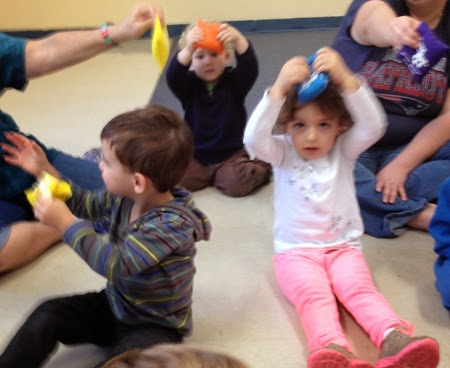
Bean bags are one of the many things in early childhood that are thought of as 'toys' and yet they are so much more than that.  It's almost as if 'toy' is a bad word, like there is no time for toys in early childhood.  We must help children get ready for school, not be treating them as if they are already there! (Remember?  It's called "Preschool".)  Toys are the tools of childhood.  It is with toys that many skills are developed because it is through play we learn how to navigate the world.  Bean bags are fun toys.  Let's break down the things that are learned when playing with bean bags.

The first aspect is tactile.  Children are feeling them.  Squishing them.  Poking them. This helps to develop the FINE MOTOR SKILLS of the fingers.  When they push down on the beans in the middlle and they move, that's SCIENCE!  They are learning displacement. When they toss a bean bag up in the air and it comes down, that's gravity.  None of these concepts need to be named.  They can just happen while children's brains get wired for understanding the concept when the time comes.

                           
Another fun thing to do with bean bags is walk and balance with one on your head, foot or shoulder. This is important for VESTIBULAR strengthening.  By taking the bean bag and placing it on different parts of the body, children are learning body parts - LANGUAGE.  


When using bean bags with children, I encourage them to 'try what I'm doing' and 'show me what you're doing'.  This allows for you to show them ideas and acknowledges they, too, can think of things to do.  CREATIVE THINKING as well as CONFIDENCE.  I also ask them to share with a friend and trade bean bags.  SOCIAL INTERACTION.


There are many songs using bean bags.  (I, myself, have composed a few.)  The combination of music with the bean bag activities intensifies the learning experience.  Music helps the children utilize the bean bags in a constructive way while making it easier to understand.  Because of music, they will retain what they've learned a bit longer as well because the music will get more areas of the brain involved in what could have been just mostly a motor movement activity.

If you haven't used bean bags in a while, it is time to revisit them.  Here is a link to quality bean bags made in the USA.   Bear Paw Creek Bean Bags   
To get a 10% discount, use code : Musicwithmar

If you are using bean bags, YAY!  Either way, here is a free song download for you.  Get out those bean bags and do the "Bean Bag Groove".  
Download here : BEANS  And use the word BEANS for the code.  
(Offer valid until Jan 31, 2015)

For daily brain facts, please visit Music with Mar. Brain Facts Page
Music with Mar. Website
Maryann “Mar.” Harman
BA Music / MA Education
Founder of Music with Mar.


Friday, January 23, 2015

All Wrapped Up

Hi! It's Scott from Brick by Brick. I love to repurpose materials—use materials in ways different from their intended use.

Well, this time I'm using "repurpose" in a little different way. Recently I was reminded that kids can use materials in ways they were intended, materials that are usually not used by kids but by adults.

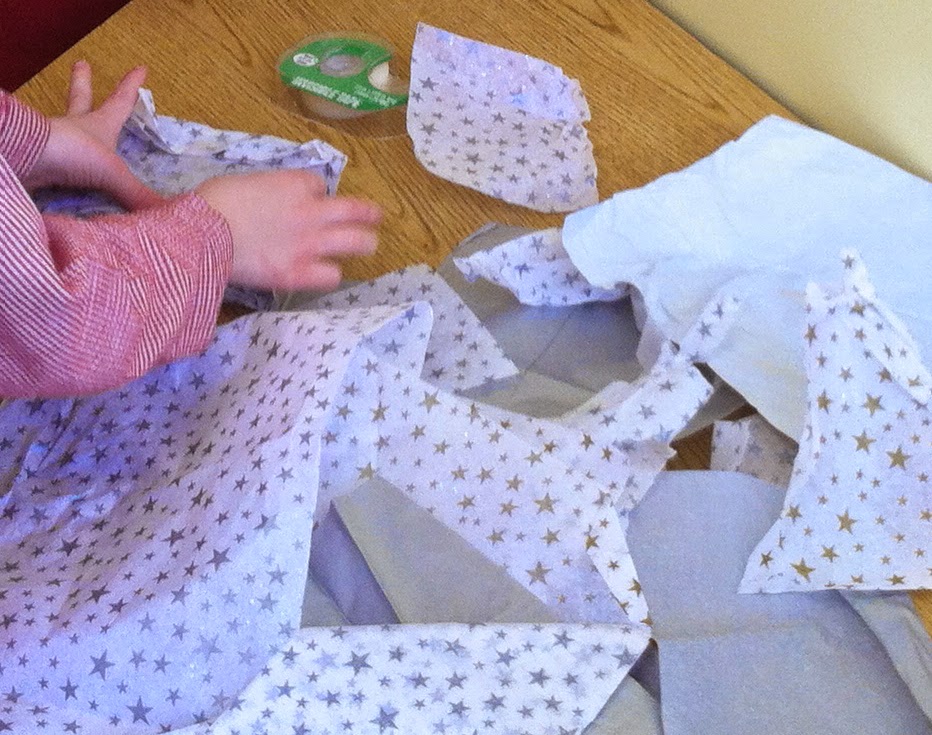
We had a "gift wrapping" experience recently in my class. Kids got to use tissue paper and clear tape. These materials are things I would use to wrap gifts myself.

Gift Wrapping (Brick by Brick)

Kids often do not get to explore these types of items. So, my kids wrapped and wrapped. They would bring me a "gift," I would unwrap and appreciate the gift, they would wrap it up again.

Gift Wrapping (Brick by Brick)

What did they wrap? Food boxes that had been stuffed with newspaper; a few wooden blocks; a couple of homemade Velcro blocks. You could give them whatever was on hand. 

Gift Wrapping (Brick by Brick)

I like using tissue paper because it is easier to fold and handle than wrapping paper. And it's much cheaper. (Don't use that expensive art tissue; get the gift wrap kind from the dollar store!)

Gift Wrapping (Brick by Brick)

You can save the tissue if you want for later collage projects. We just tossed it after our exploration was a wrap.

Think of ways you can give kids adult tools or materials that they can explore and use themselves. I posted about glue guns and staplers in the past. Kids could use screwdrivers or hand drills, mixing bowls and whisks, spray bottles and dish cloths. We have even used a drying rack when we washed our play dishes. 

Look around the house. Walk through the store. Kids love to use those adult materials. What can you explore?

Thursday, January 22, 2015

Nurturing Future Arts Lovers


Best Wishes for 2015!

Most of my writing about movement has focused on the importance of providing children opportunities to participate in the arts.  Today I am writing about nurturing engaged and interested arts audience members.

An important part of learning to appreciate dance, music, theater and other arts is to learn how to be an attentive and courteous audience member.    
We can do that with young children in the classroom by dividing the class into two or more groups and allowing each group to show, describe, perform, etc., whatever artistic endeavor they happen to be exploring.  The non-performing group or groups in this case becomes the audience.  I like to use this opportunity to explain what it means to be a polite audience member.  First of all, of course, I remind them that this is the other children's chance to perform, and the audience must be respectful of them and give them their full attention.  For very young children, I give them a task while they are watching, which becomes their focus and helps them to concentrate.

For example, let's say we are playing a movement game about making snowflake shapes.  


Making a snowflake shape!
Another snowflake shape!


Another snowflake shape!
I give the audience group a "watching task" such as:  "Watch the other children and see if you will see someone making a pointy snowflake shape, and also watch for a curvy snowflake shape!"  Before you change groups and it is their turn to "perform," follow up by asking them what they saw, and allow them to offer other ideas about what they noticed the other children doing.  They may also want to tell you what they are going to try when it is their turn to dance.  This has the added benefit of stimulating ideas for all of the children as they explore the movement game.  


I give a similar but different set of tasks when it is the other group's chance to "perform." ("Watch for a snowflake shape that is turning!" "Watch for one that is low to the ground!").  If I do this exercise periodically over the course of the year, the children become more comfortable waiting for their turns, and also are more involved in the whole activity of the group.  It has the added benefit of adding to a child's excitement to perform when it is his or her opportunity to shine.  These are all positive outcomes for an activity that on its face is passive (watching other children while waiting their turns), but it is not difficult to turn it into one that is engaging for the children.  

Most communities offer concerts, performances, museum exhibits, and other art events that are geared toward children.  Another suggestion I would make is to look for opportunities to attend dress rehearsals which are often open to the public and have a more informal atmosphere than the actual performance.  I obtained permission from the Cincinnati Ballet to bring my granddaughter to a dress rehearsal of Peter Pan.  She had just turned one, so my daughter-in-law and I didn't know what to expect.  It turned out that my granddaughter sat quietly for about a half hour, completely enraptured by the music and dance.  And, because it was a less formal setting than if we had taken her to see the full-length ballet, we could leave quietly when she was ready to go, without disturbing anyone.  


Other quick tips for taking children to and getting the most out of arts events, include checking the arts organization's website for educational enrichment related to the presentation, making sure to arrive with plenty of time for the children to become accustomed to the space, and checking for opportunities to meet the performers after the show.

In addition to introducing children to many different art forms and ways of looking at the world, you will help to foster lifelong appreciation in the delights of art, theater, and dance.


Keep on dancin' in 2015,

Connie
MOVING IS LEARNING!


Related Posts Plugin for WordPress, Blogger...