Sunday, February 16, 2014

A Snowball Freeze Fight for Fun and Learning!

   Miss Carole of Macaroni Soup here in frigid, snowy Chicago.  BRRR!

Oh no!  Look out from behind!
    If you’re in the major part of the US/Canada that has had one whoppingly snowy Winter – and it’s not over yet – you may be getting The Indoor Crazies about now. Your students may be exceedingly squirmy, poke-y, silly, sad-ish and LOUD!  If the snow hasn’t kept you inside, the sub-0 temps and windchills have!
         I have a cure!

    Okay, it’s a temporary fix, and may need almost daily repetition – 
but there’s no chance of an overdose on this one!  

Have a Snowball Freeze Fight – right in your classroom!  

I developed this activity for my “Boy Class” about 15 years ago – there were 10 boys and 2 girls in a 4-year-old preschool class.  By February, their teachers arrived at music class hoping I would run them hard, make them jump and twirl for 30 minutes and hand them back ready to return to the classroom to learn and play.  The students particularly had trouble with self-control, listening and following directions.  Hmmm.  Not just a boy issue – everyone can use re-enforcement on these skills!

FREEZE!
    I created Snowball Fights – we’d pretend to throw snowballs at each other, stopping  (freezing) anytime the music stopped.  It worked pretty well.  Then a package arrived in the mail from Oil of Olay.  A net pouf or loufah.  I thought, “What a lousy sponge … but… but what a wonderful snowball!”  WOWSA!  I wrote to OOO, and asked them to sell me 40 loufahs “for educational purposes.”  They did – they even picked up the shipping!  And the Snowball Freeze Fight was on its way, travelling across the country, teacher-to-teacher as I shared it at conferences and workshops!

    Here’s how a Snowball Freeze Fight works:
1. Acquire about 2 poufs per person participating.  See resource below.

2. Find music with starts and stops built in – a freeze dance, or “The Freeze” on my “Dancing Feet!”cd.  
   This is an auditory game – please don’t stand at your music player and stop and start it.  Children will begin to watch you for to see when you press the button instead of listening for the music to stop.  Plus it prevents you from joining in the fun – an important consideration!

3. Explain The Two Rules:
            Rule #1:  No throwing at faces.  You may throw at bodies, 
                          backs, legs – not at faces.
            Rule #2:  You may only hold ONE snowball at a time.  
                          If you hold more than one (demonstrate), you are a 
                          Snowball Piggy, and no one wants to be that!

4. Practice “freezing”: while sitting, put hands in the air and wiggle them saying “hands in the air, hands in the air, hands in the air, FREEZE!”  Repeat.

5.  You’re ready!  Turn on the music and let the snowballs fly!
      (I toss them into the air from my big bag – they squeal with delight!)
    
The Snowball Freeze Fight in concert - with about 250 children!

     About 2 minutes of music is plenty!  On your final “Freeze”, instruct the children to bring all the snowballs back to your bag when you say “Un-Freeze”, then sit on the floor where they started.  Have ready a VERY engaging, quiet-er activity or book.  
     I love to do the SFF in the middle of The Snowy Day by Ezra Jack Keats –


when Peter would love to be in the snowball fight with the big boys, but he isn’t ready, not yet.  I pause, put the book down and ask, “Would YOU like to have a Snowball Fight?”  And we’re off!  Then, when we’ve had our SFF, I pick up the book and we see what happens to Peter next!
 
This picture isn't blurry - they're scurrying for snowballs so fast the camera can't keep up!
RESOURCE:  I now buy the mesh poufs from BathEssential.com for under 50 cents each (12 in your classroom?  Buy 30 for $15 plus shipping – a bargain!  The more you buy the cheaper they are, so see if other teachers want them, too!)
    A note to pacifists – yes, the word “fight” may trod on the edges of your comfort zone.  You could call it a Snowball Toss or Throw. But trust me, when done with smiles and laughter, children get that it’s not a brawl.  Children cannot get hurt if they follow the simple instructions you give them.  They get a workout, practice listening and following directions, learn self-control, have an incredibly fun 2 minutes, and you get children back in the groove, ready to play and learn! 
NOTE:   I always remind them that on the playground we never throw real snow at others.


    For more information about this activity, check out the January 2010 Song of the Month page on my website.  This activity works with children 2 – adult (yes, these are teachers in a workshop pictured left!) I’ve done it with 1000 people (not recommended), but it is especially fun for classrooms.  Try it on a Parent Participation Night!  It’s a hoot!  


Any questions?  Try it!  Let me know how it goes!

Yours for a Winter Song!
 “Miss Carole” Stephens

Saturday, February 15, 2014

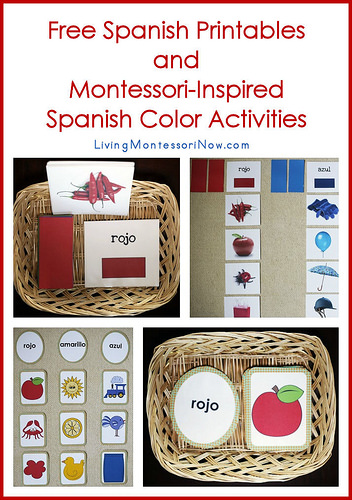
Montessori-Inspired Spanish Color Activities Using Free Printables

Free Spanish Printables and Montessori-Inspired Spanish Color Activities By Deb Chitwood from Living Montessori Now 

Many Montessori schools teach a foreign language. In the U.S., the language is often Spanish. I don't know a lot of Spanish, but I always enjoyed teaching the few concepts I knew in Spanish to the preschoolers I taught. 

Today, I'm sharing some free printables and Montessori-inspired activities for introducing Spanish colors. You'll find many activities for preschoolers through first graders throughout the year along with presentation ideas in my previous posts at PreK + K Sharing

You'll also find ideas for using free printables to create activity trays here: How to Use Printables to Create Montessori-Inspired Activities.

Disclosure: This post contains Montessori Services affiliate links at no cost to you.
 
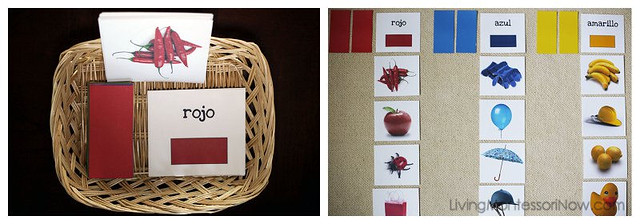
Color Tablets and Spanish Color Matching Activity 

Color Tablets and Spanish Color Matching Activity  
For this activity, I used the free Color Matching Cards from Montessori Print Shop and the Spanish Color Matching Cards from Homeschool Creations.
I put the cards in a small willow basket and used a a large hemmed work rug from Montessori Services for the layout.

Laminated Montessori Print Shop color matching cards are all that are needed for a homeschool or many preschools. You really don't need to purchase Montessori color tablets, especially for home use. You can find presentations for introducing Montessori color tablets in my DIY Color Tablets post at Living Montessori Now. 

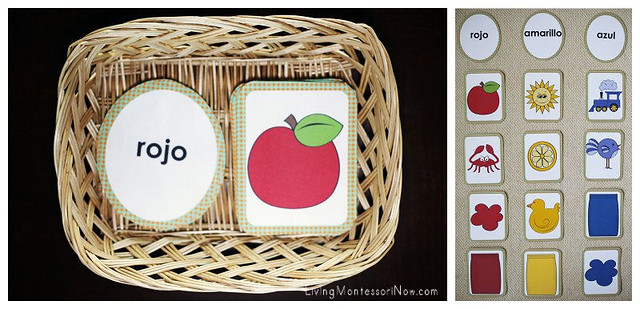
Spanish Color Matching Activity 

Spanish Color Matching Activity

This activity uses Los Colores color matching game or activity by Carolyn from Wise Owl Factory. In the printable pack, there are directions for using the printables as a game. Here I used them as a Montessori matching activity.

Again I put the cards in a small willow basket and used a a large hemmed work rug from Montessori Services for the layout. To create a control of error (self-check), I placed a small matching color dot on the back of each of the Spanish word cards. 

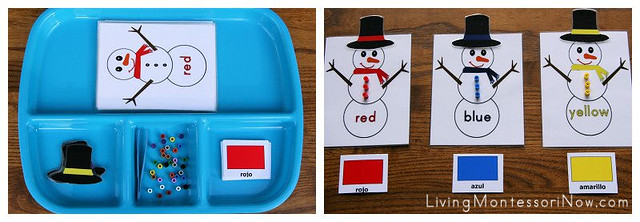
Snowman Spanish Color Activity 

Snowman Spanish Color Activity

In case you haven't seen this before, I have a Montessori-Inspired Snowman Color Activity with Spanish color cards in a previous post here at PreK + K Sharing. You'll find ideas for preparing and presenting the activity.

Color Tablets, Yarn Balls, and Spanish Colors

Color Tablets, Yarn Balls, and Spanish Colors

In my post at Living Montessori Now with Montessori-Inspired Color Activities Using Yarn Balls and Free Printables, you'll find another Spanish color-matching activity.

More Montessori-Inspired Spanish Activities 

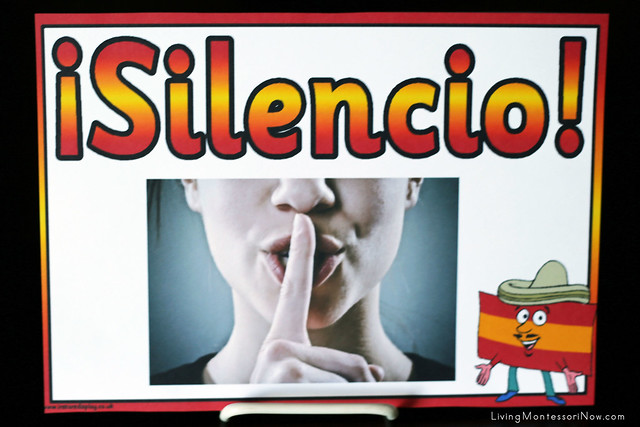
Spanish Silence Game Sign

Spanish Silence Sign

I love the Montessori silence game. It’s wonderful for helping children develop self-control and self-discipline. You can find a Spanish version of the silence game in my Montessori-Inspired Little Passports Activities - Mexico. 

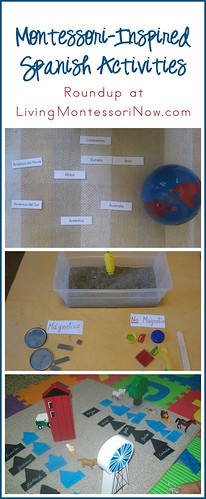
Montessori-Inspired Spanish Activities Post 

Montessori-Inspired Spanish Activities

I have a Montessori-Inspired Spanish Activities roundup post with more ideas. 

More Free Spanish Printables 

Go to my post at Living Montessori Now for links to lots of Spanish freebies from around the blogosphere: Free Spanish Printables and Montessori-Inspired Spanish Color Activities.

Presidents' Day Activities

Happy Presidents' Day Weekend if you live in the U.S.! For Montessori-inspired Presidents' Day activities, check out these posts: Montessori-Inspired Activities Teaching about Money and Presidents, Montessori-Inspired President’s Day Activities, Free Presidents’ Day Printables and Montessori-Inspired Presidents’ Day Activities.

Montessori at Home or School - How to Teach Grace and Courtesy eBookIf you'd like to focus on manners with children, please check out my new eBook Montessori at Home or School: How to Teach Grace and Courtesy! It's written for anyone who'd like to feel comfortable teaching manners to children ages 2-12.

Have a great weekend!
Deb - Siganture

Deb ChitwoodDeb Chitwood is a certified Montessori teacher with a master’s degree in Early Childhood Studies from Sheffield Hallam University in Sheffield, England. Deb taught in Montessori schools in Iowa and Arizona before becoming owner/director/teacher of her own Montessori school in South Dakota. Later, she homeschooled her two children through high school. Deb is now a Montessori writer who lives in Colorado Springs with her husband of 38 years and their cat of 12 years. She blogs at Living Montessori Now. 

May be linked to Afterschool Express, Thoughtful Spot, Tuesday Tots, The Mommy Club Resources and Solutions at Milk and Cuddles and Crystal & Co., Mom’s Library, It’s Playtime, The Weekly Kid’s Co-op, Hearts for Home Blog Hop, Learn & Link, TGIF Linky Party, Preschool Corner, Ultimate Homeschool Pinterest Party, Sharing Saturday, Saturday Show & Tell, Share It Saturday, Show-and-Share Saturday, The Sunday Showcase, Link & Learn

Thursday, February 13, 2014

Why Some Children Behave Better at School, Then at Home?

Based on helping thousands of parents over the years and spending time evaluating children while they interacted with both parents AND teachers, I’ve found that it is common for children to behave the worst while in the care of Mom!  As strange as this may seem, it is true.  The reason is that in general terms, the mother seems to create a safe environment in which a child can be him or herself. 

For example, a child craving more attention or power, two common internal needs, may be more likely to act out the desire for these unmet needs in her mother’s presence, rather then anyone else’s.  The more distant in relationship an adult is to a child, the more likely they may be at gaining a child’s cooperation and attention.

If this theory is true, what can mothers everywhere begin doing to address this frustration?  Here are 10 things you’ll want to incorporate quickly that may be similar to what the teachers are doing at school.  If you’re doing some of these now, good job and keep them going.  If you’re not, make the time to implement them soon.

LIMIT SCREEN TIME.  Remember the phrase, “All good things in moderation.”  Too much screen time can create anxiety in a child if it is not controlled and the parent needs the child’s cooperation.

CONDUCT FAMILY MEETINGS.  They don’t have to be long and drawn out, and can even incorporate fun activities.  The best thing about family meetings with younger children is that they are usually short.

SPEAK CALMLY, QUIETLY AND RESPECTFULLY.  Children will often quiet down to hear the adult speak.  Be sure that you’re demonstrating the kind of communications that you want him to emulate.

COMMANDING AND DEMANDING DON’T WORK.  We no longer live in an autocratic world, so avoid using the parenting methods our parents used.  Teach, demonstrate and use cooperation.

LISTEN QUIETLY WHEN SHE COMPLAINS.  Shutting a child down who is complaining will only back fire on you.  Practice emphatic listening with your child and avoid solving her problems for her.

THE RESPONSE TO “I’M BORED” SHOULD BE “WOW!”  Boredom is a problem owned by your child, not you.  When it occurs, listen at first and be expressive to acknowledge the problem, don’t rescue.

LET TANTRUMS HAPPEN.  When your child throws a fit in response to a limitation or boundary, let it happen.  The fit is his way of venting frustration and also hoping you’ll give in.  Don’t cave!

PUNISHMENT IS NOT THE ANSWER.  The use of timeout, taking things away, hitting, or yelling are NOT OK.  Nor are they productive in managing behavior effectively and with unconditional love.

TALK LESS.  Talking too much to your children will undoubtedly send them into ‘parent deafness.’  If you feel they’re not listening to you, it might be because you’ve trained them to tune you out.


VISUAL TIMERS AND SCHEDULES.  Setting the microwave timer to get a child to stop or start an activity does not work.  Seek out visual timers and visual schedules to increase your effectiveness with transitions.

Bill Corbett has a degree in clinical psychology and is the author of the award winning book and parenting class, “Love, Limits, & Lessons: A Parent’s Guide to Raising Cooperative Kids."  He has three grown children, two grandchildren, three step children and lives with his family in Enfield, Connecticut.  You can visit his Web site www.CooperativeKids.com for further information and parenting advice.

Get his article on the above Website for next Valentines Day, "14 Days of Loving Your Child."  It offers one tip per day for every day of February, leading up to Valentine's Day.

Friday, February 7, 2014

10 Ways To Help Children Enjoy Dental Health


Hi! I'm Ayn and I am a Ga. Pre-K teacher, serving 4 and 5 year olds in an inclusive setting. I share my classroom adventures on my blog, little illuminations.

Did you know February is Dental Health month? It's a great time to help kids get familiar with dental visits and dental routines. Many children are afraid of going to the dentist. One of the best ways to alleviate a child's fear of the dentist is to help them learn about visiting the dentist and what to expect. Today I'm sharing some ways to help children learn about dental health/hygiene AND ways to make the learning fun!


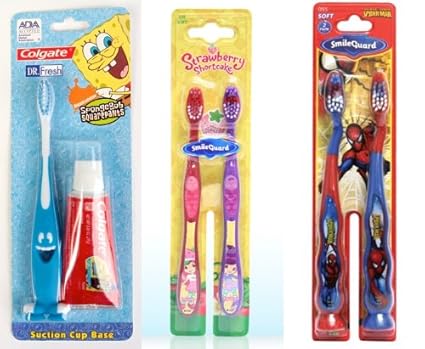
1. Get a fun toothbrush and tasty toothpaste and let your child help pick them out! There are lots of fun toothbrushes for children these days. Some light up, some play music, you can personalize or decorate some or get one with a popular character on it. 
   Now, let's talk toothpaste. I'm going to get personal for just a minute and let you in on a little family secret here. I have a teenager with special needs. She had a horrible smile. Her teeth were crooked, her smile was misshapen and she had a yellow tinge (common in our family). We found a local dentist that had a scholarship program that would provide dental and orthodontic work that we never could have afforded. Her smile was fodder for the bullies that plagued her every day. We applied and got the scholarship. Fast forward a couple of years and the braces are off and she has an absolutely beautiful smile!!!! Here's the tricky part---she wouldn't brush her teeth. After all this work, we were nagging and cajoling her morning and night to brush. She would "forget" more often than not. Recently, we've discovered a big part of the problem---toothpaste!!! She was using regular adult paste and with her food/sensory issues, the minty taste really bothered her. I mean REALLY, REALLY bothered her. So we went back to children's toothpaste with kid friendly flavors and she's brushing regularly again. If using bubblegum paste makes the difference between brushing and not brushing, we'll do what we have to. 


image courtesy of Amazon.com

2. Use a tooth brushing chart to remind kids about brushing and help set some goals. Help your kids get in the habit of brushing at least twice a day. Using a tooth brushing chart helps provide a visual reminder for kids until the habits become second nature. There is a great chart on my blog, little illuminations sent to me by "Love Your Teeth". Click here for the link. It can be personalized and is printable. Teachers---you can enter in a class list and print one for each student! 

3. Read some fun books about teeth and dental health! There are tons of great books out there, but I'll share some of my favorites below!


4. Play games! Honestly, most of the games we've played this week accented our math skills but had a dental theme. That's okay! 
  I printed out a coloring page of a toothy smile and laminated it. The kids roll a die and color in cavities on the appropriate number of teeth. At the end of the game, we compare the number of cavities, then brush them all away!


I have a board game, courtesy of Colgate's Bright Smiles Bright Futures program. I don't know if they still send out kits to classes, but the board game has lasted several years and is a fun little game. You could also easily make a game board with a file folder and colored dots. 


5. Identify "tooth friendly" foods/drinks and foods/drinks that aren't healthy for teeth. Yesterday, I let the kids get some cutting practice in by cutting out some pictures of food and pasting them on paper. (recycled women's magazines and grocery store sale flyers are EXCELLENT for this!)  I really didn't give them any guidelines---I just instructed them to cut out any food pictures they wanted. 


I made 2 giant tooth cut outs, one with a smile and one with a frown. I explained that the tooth with the happy face was for healthy foods and the sad face was for junk food and sweets.


 I asked the children if they thought they had healthy foods to sit down by the tooth with the smile and if they had junk foods or sweets to sit by the sad tooth. We then looked at each student's picture and talked about why they sat where they did. If, after discussion they were by the wrong tooth, we encouraged them to find the right tooth and sit beside it. 


Later, we posted the pictures on or near the right tooth and displayed them on our classroom wall.


6. Explore the damage soda, tea, coffee and sugar drinks do to our teeth by experimenting on hard boiled eggs. Soak each egg in a different drink and observe after several hours or overnight. For additional investigation, have students use a toothbrush to try and clean the stains off the egg. This hands-on experiment really helps them see the damage done.


7. Talk about the tools used in proper dental health. We examined and explored toothbrushes and floss. We explored how to use them properly.


We played a little simulation, using the children as teeth and a jump rope for the floss. I then "flossed" between the children!


Later, use toothbrushes and dental floss to make art! (Sorry, no pics for this one.) Use the toothbrushes as paintbrushes. Drag the floss through the paint like you would with string art. These turn out wonderfully creative and unique!  (If I am able to get a few shots later, I'll try to add them!)

8. Make a giant mouth and count out marshmallows, packing peanuts or cotton balls to make the teeth.


Or, use playdough to make a mouth and place beans to make teeth!


9. Set up a mock dental office. This is a favorite center to explore every year!!! I don't have any specific "dental tools", just items pilfered from a toy doctor kit, a few toothbrushes, rubber gloves and dribble bibs made from napkins or paper towels clipped to string with clothes pins. 


The reception and waiting area is also a very popular place to play. the kids make appointments, type on an old keyboard and answer the phone while others  thumb through magazines while waiting their turn for dental work!


10. Visit and tour a children's dentist BEFORE your first appointment. Knowing what to expect goes a long way in alleviating a child's fears. Many of the children's dentists really make the appointments fun and this helps the  children get excited about going to the dentist! We have FABULOUS children's dentist in our area that really goes all out for our visits. After touring the work areas, the children are given a dental health lesson from the Tooth Fairy. 


The Tooth Fairy also visits our younger students in the school to talk about dental health, as well!  


Before we visit, we always talk about what the kids think a dentist does. They can compare their answers with their observations after the visit. It may also give an indication if there are unfounded fears or misconceptions that are easily cleared up.


As a child, I had several very bad experiences at the dentist. My hope is that by making dental visits and hygiene fun, my students will look forward to visiting the dentist and perform proper oral health habits. No child should ever fear or dread the dentist the way I always have. I hope some of these ideas are of help to your little ones, too!

Stop by and visit me anytime at littleilluminations.blogspot.com or visit the little illuminations fanpage on facebook! And be sure to check out PreK+K Sharing EEE!


Related Posts Plugin for WordPress, Blogger...