Sunday, January 18, 2015

MULTICULTURAL CHILDREN’S BOOK DAY – THE LIONS OF GIR


#ReadYourWorld: Celebrating Children, Diversity and Humanity

“Our mission is to not only raise awareness for the kid’s books that celebrate diversity, but to get more of these of books into classrooms and libraries.”

Hello, everyone. Ms. Brigid here, from Merit School of Music  in Chicago, IL. Thank you for joining me. I’m starting off 2015 by promoting books and multicultural literacy through the 2nd annual Multicultural Children’s Book Day (MCCBD), #ReadYourWorld.

Co-founders Valerie Budayr from Jump Into a Book, and Mia Wenjen, from Pragmatic Mom write, “Despite census data that shows 37% of the US population consists of people of color, only 10% of children’s books published have diversity content. (We’re) on a mission to change all of that….to not only raise awareness for the kid’s books that celebrate diversity, but to get more of these types of books into classrooms and libraries....Our young readers need to see themselves within the pages of a book and experience other cultures, languages, traditions and religions within the pages of a book.” 

Young readers won’t find access to these books, however without adult help – from parents, caregivers, teachers, librarians and booklovers - and bloggers! That’s where I come in. I’m one of over 150 bloggers writing posts on a multicultural book this month! On January 27, 2015, all contributing bloggers – and their book reviews – will be linked together on the MCCBD site for a multi-faceted gala reveal.

MCCBD is also partnering with First Book to create a Virtual Book Drive for the event, and with The Children’s Book Council to offer readers quality resources. Be there or be ☐. No worries, however, the resource will be archived on the MCCBD website for all eternity…or until the internet ends, whichever comes first!

I was delighted to be matched with Meera Sriram, an author born and raised in India, now living in the U.S. In our introductory emails, Meera wrote, “When I decided to follow my heart and start writing for children, I really wanted to address the void in the children's literature scene in India. I now have four books published in India.” The book she chose to share was Dinaben and the Lions of Gir, co-authored by Praba Ram. http://www.tulikabooksusa.com/Dinaben-and-the-Lions-of-Gir-978-81-8146-761-4.htm.

The book opens a window into the world of the Maldhari community of Gujarat, India, some of who live in the Gir Forest. A bit of backstory may be helpful: The Gir Forest is famous for being sole remaining habitat for the Asiatic lion, and the Gir Forest National Park  and Wildlife Sanctuary were established for their protection. No human activity is allowed in the National Park, and only the Maldhari, famous for their dairy farming, are allowed to graze their cattle in the adjacent Wildlife Sanctuary. The Maldhari and the lions have coexisted for centuries, but the existence of both is challenged by other complex issues. 

 
In the first part of the book, the reader is introduced to Dinaben and the world she occupies. Standing in her house between suspended silver-colored water vessels, the richness of her clothing, and the textiles of other Maldharis shown on the next page, stands in stark contrast to a modest way of life.

Dinaben’s village is in the middle of the Gir Forest, home to a vast array of plants, birds and animals – including lions! The domestic cows and buffalos of the villagers also graze in the Gir. This can cause problems: “Sometimes, there are accidents among animals and humans. Generally, the Maldharis do not trouble the animals in the forest. They are busy with their work.”

The last part of the book looks closer at what Dinaben does during her day whlle her husband is busy with their cattle.  

Dinaben also is responsible for churning butter, making curd from milk, and making ghee, similar to clarified butter.  Her husband, as is the custom, takes these products to sell.  The book ends, "The Gir is Dinaben's home. It also belongs to the lions. So, let us help protect the forest."


What I liked:
-The book sheds light on a part of the world and a way of life very different than what is generally known in the U.S. It is also shows how rural people live and work (dairy farming) in relatable terms for young children – with the additional bonus of lions in the neighborhood! 

-The book’s photos document a wide variety of animals and birds, most of them uncommon to North America.
-Text is straight-forward and bi-lingual. The book I received had Tamil and English text, but is available in multiple languages, including Hindi, Telugu, Gujarati, and others.
-Many pages include a charming line drawing of a playful young lion, which adds a touch of whimsy to an otherwise strict, non-fiction presentation.
-The “More about lions” at the end of the book, offers kid-friendly information on lions in general, and clearly describes the differences between Asiatic and African Lions.


What I would have liked:
-More connection between the two stories.
-The development of a clearer message. The ending, “….let us help protect the forest.” gives no clear directive or action plan.
-People-animal conflict is alluded to, but in vague terms. The photos could better support the text, “Sometimes, there are accidents among animals and humans.” I can imagine the authors wanting to be sensitive on this subject, given that the book is written for children 4+-6 years old. More information for the adult reader (me) would have been helpful, perhaps as an afterword. That being said, the book is written for children living in India, so perhaps the adults reading it there are already well informed about Gir, the lions, and the Maldhari, in a way that I wasn’t.
-More, and larger photos of Dinaben and Maldhari life. Captions of what is portrayed would have been helpful.  
-I would like to know more about Dinaben – how she felt about her life, the lions, or what gave her pleasure.

After I finished reading the book, I wondered about what Dinaben wondered, e.g., what did she think about her family, her life, and the lions. What inspired her exquisite textile work? It also made me curious about the Asiatic lions, the Maldhari, and the resettlement of families that took place when the preserve was created. I spent hours searching the internet for articles and images on both subjects. Final verdict: The book made me care about Dinaben and prompted me to go on a further journey. I would share it with young children.

Connections:
Many ideas for pre-K and K family and classroom connections come to mind. Some of the following activities were suggested by my friend, Allison Ashley, who teaches at Covenant Nursery School.
1.    Make butter.
2.    Bring in ghee – widely available in grocery stores – and serve it with crackers.
3.    Explore lion lore, using the book’s  “More about lions” pages. Play Saint Saen’s “The Royal March of the Lion”  from Carnival of the Animals, and invite the children to move like lions, with the occasional “roar” thrown in.
4.    Provide paper, glue, and brightly colored tissue paper for children to make their own artwork inspired by Dinaben’s appliqué and stitched textile. Talk about geometric and organic shapes, repeated patterns. Invite the children to include family pets in their compositions.
5.    Share Indian “nursery rhymes” or simple songs. Mama Lisa’s World is a great place to start.

Day by day, more bloggers are publishing their reviews, which can be found on MCCBD ‘s Twitter (https://twitter.com/MCChildsBookDay) or Facebook page (https://www.facebook.com/MulticulturalChildrensBookDay). These links will not work if you do not have an account. More information can be found on MCCBD’s paper.li, https://paper.li/MCChildsBookDay/1419776073#, an intriguing, new (yes, another new thing) social media platform.

Multicultural Children’s Books Day would not be possible without the help of MCCBD’s 2015 Sponsors:                                                                                          


I am continually inspired by The Children’s Music Network (CMN) community. an international group of socially conscious musicians, educators, librarians, families, songwriters and good people, who “celebrate the positive power of music in the lives of children by sharing songs, exchanging ideas, and creating community.” Please visit CMN, and find a gathering in your region.

©2015 Brigid Finucane  * 847-213-0713 * gardengoddess1@comcast.net
http://prekandksharing.blogspot.com
http://brigidfinucane.blogspot.com
@booksinger1

BLOG HISTORY

Friday, January 16, 2015

Friendship In Action With Music!

   Miss Carole of Macaroni Soup here in chilly Chicago! After finally coming back from Winter Break and Weather Interuptus Days, I love introducing songs that promote friendship.  In February we get all lovey-dovey for Valentine’s Day – but what does that mean to a young child?  I go for the angle of being kind to our friends, caring to our families, and sharing the joy of music-making and dance.

   This month I’ll introduce you to three of my favorite songs and dances that promote sharing, caring and fun through music and movement.  
                        Here we go!

1. Who Will Be My Friend Today?
    The tune is “Here We Go ‘Round the Mulberry Bush” – hear it here.  The activity is fairly simple.  Make 2-3 hearts – they can be paper (single use) or plush or felt (multiple uses.)  My hearts are felt with a little stuffing, then hot glued around the edges.  They’ve lasted years!

THE SONG:        Who will be my friend today,
                        Friend today, friend today?
                        Who will be my friend today,
                        This bright and sunny morning?

                        You will be my friend today,
                        Friend today, friend today!
                        You will be my friend today,
                        This bright and sunny morning!

WHAT TO DO:
For Preschool:  Everyone sits together in the middle of the room (or rug, or any open space.)  The teacher gives the hearts to 2-3 children - if your group is fewer than 8 children, you may use 2 hearts, use 3 hearts for larger groups.  The children with the hearts walk around the group while everyone sings the first verse.  Then each child gives their heart to a sitting friend, taking them by the hand to walk around the circle with them as everyone sings the second verse.  The hearts are collected by the teacher, who gives them to new children.  Repeat the sequence until everyone’s had a chance to go around the circle.

For K’s:  Everyone sits together in the middle.  The teacher gives the hearts to 3 children, who walk around the group while everyone sings the first verse.  Here’s where it’s different for some groups.  If your children have become self-conscious about holding a classmate’s hand, as I occasionally find with K’s, the game becomes a hand-off – with the new carrier of the heart now going around the circle and the original carrier sitting in their place on the floor.  You may have to try it once to see how your class reacts. In this case, you would only use the first verse.

NOTE:  I ask children to only give the heart to someone who has not walked yet. “If you haven’t walked yet, raise your hand silently so that the walkers know who they can choose. Should a friend offer you a heart and you've already had a turn say 'Thank you, but I've already had a turn.'”

Jump Jim Joe!
2. Jump Jim Joe! 
    This is one of my absolute favorite partner dances!  Hear it here.  It’s a folk dance of the best tradition!  Please learn this song well enough to sing it with your students at a slow enough tempo for them to do all the dance moves.  You may never use the recorded music – I don’t!  We need the slight pauses (P) I put in at the end of each action so that everyone can do it well.
THE SONG:     
        Jump, jump, jump Jim Joe
        Nod your head (P) and shake your head (P)
        And tap your toe.
        ‘Round and ‘round and ‘round you’ll go
        Now you find another partner
        And you jump Jim Joe!

THE DANCE:    Each child faces their partner, holding hands. 
        Line 1:  They jump!
        Line 2:  Nod heads up and down - demonstrate “yes”
                    Shake head – demonstrate “no”
        Line 3: Tap toe to the side (still holding partner’s hands)
        Line 4: Two hands circle – not too fast!
        Lines 5-6: Find a new partner – someone you haven’t yet danced with!
...And tap your toe!
'Round and 'round and 'round you'll go...


 I do "Jump Jim Joe" with three year olds through school-aged children, and they LOVE IT!  Also great for mixed-age groups and parent participation events!


3. THE MUFFIN MAN DANCE!
Yes, I know the Muffin Man!
    This one is for the youngest among us – 3’s and younger.  Not that a 4 year old won’t enjoy it – it’s a great introductory partner dance – because it’s VERY simple!  Hear it here.

THE SONG:      
Oh do you know the Muffin Man,
The Muffin Man, the Muffin Man?
Do you know the Muffin Man
Who lives in Drury Lane?

Yes, I know the Muffin Man,
The Muffin Man, the Muffin Man!
Yes, I know the Muffin Man
Who lives in Drury Lane!


THE DANCE:  Help children choose partners – they’ll be keeping their partners in this one!  They hold “inside hands” so that they can walk together around the room (as they did with the hearts in our first song.)  For the first verse, couples walk hand-in-hand around the room.  For the second verse, they face each other and clap hands pattycake style.  Repeat! 


REMEMBER: Demonstrate the dance before inviting the children to stand and join in. Use another teacher OR a child to help show what to do (choose your partner wisely!)  
   There you go!  Get those dancing feet moving – especially when the weather prevents you from going outdoors!  It’s not just good for the kids, if you know what I mean…

Yours for a Song and Dance!
“Miss Carole” Stephens


Thursday, January 15, 2015

Montessori-Inspired Valentine Activities Using Free Printables

By Deb Chitwood from Living Montessori Now 

I have so many great memories of valentine activities as a Montessori teacher and homeschooler! I also have lots of fun Valentine's Day memories from when I was a child. 

So I had a great time searching for free valentine printables for this post. There are lots and lots of awesome valentine printables available, so I limited my post at Living Montessori Now to free valentine learning printables. 
 

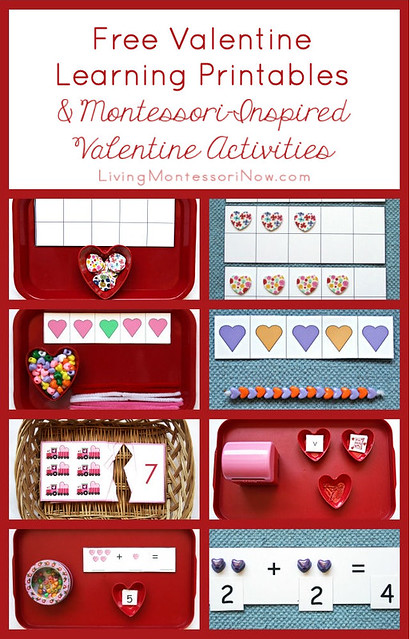
Free Valentine Learning Printables and Montessori-Inspired Valentine Activities 

I shared my list of free valentine learning printables in my post today at Living Montessori Now. Here, I've created some valentine activities using free printables for preschoolers through kindergarteners. 

You'll find many activities for preschoolers through first graders throughout the year along with presentation ideas in my previous posts at PreK + K Sharing. You'll also find ideas for using free printables to create activity trays here: How to Use Printables to Create Montessori-Inspired Activities. 

At Living Montessori Now, I have a post with resource links of Free Printables for Montessori Homeschools and Preschools.  

Disclosure: This post contains affiliate links at no cost to you.  

Heart Button Sorting and Counting

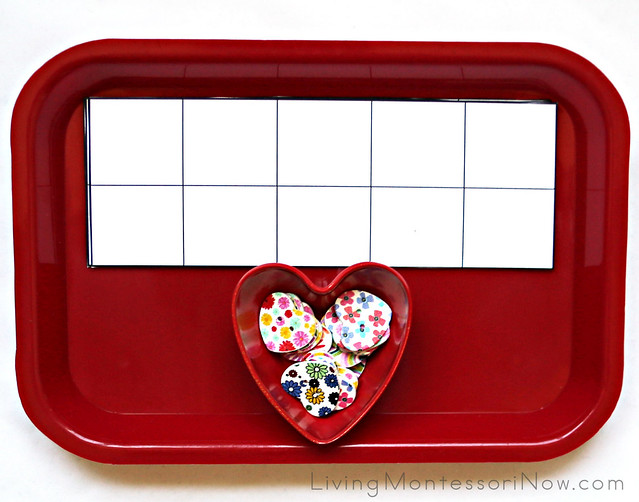
  Heart Button Sorting and Counting For this activity, I used the free Blank Ten Frames at Teachers Pay Teachers. I found these heart-shaped painted wooden buttons on Amazon. They arrived quickly and are very cute. I love the feel of them for sorting activities. They would be awesome for a Montessori-inspired sewing activity, too. 

I used a medium-size tray from Montessori Services. I found small heart-shaped bowls at my grocery store a couple of years ago, but I'm not sure if they're still available anywhere. 

The button-sorting activity is wonderful for visual discrimination skills, and I used the ten frames to add a math activity. I typically use one design or color of material for a counting activity (see "Isolation of Quality"), but I wanted to include a sorting activity to make the activity more challenging. 

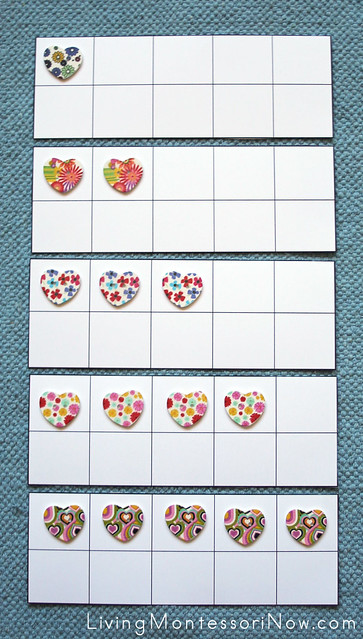
Young preschoolers could lay out the ten frames on a rug in any order. (I used a Montessori Services rug for my layout.) After the buttons are sorted on the ten frames, the child could line up the ten frames as shown below. 

Older children could focus on addition by using the ten frames to see which number could be added to the number shown buttons to get a sum of 10. 
 

Heart Button Layout  

Heart Patterning Activity 

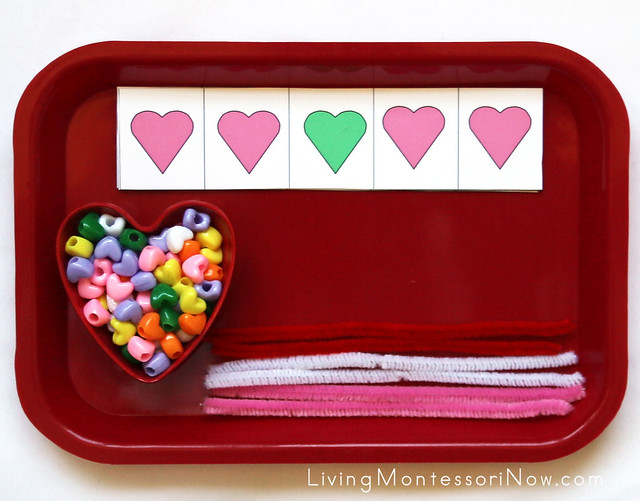
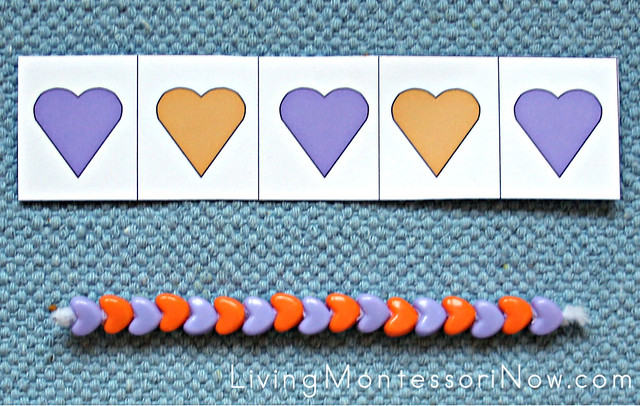
  Heart Patterning Tray This activity uses the free Heart Patterning printable by Two Preschool Gals at Teachers Pay Teachers. There are 4 different patterns. 

I used the same type of tray and bowl along with pipe cleaners cut in half and heart-shaped pony beads in the colors on the printable. 

Children could use as many beads as they wish to continue the pattern on a pipe cleaner. They could make a bracelet following the pattern, too. 
 

Heart Patterning Layout  

Valentine Transportation Count and Match Puzzles

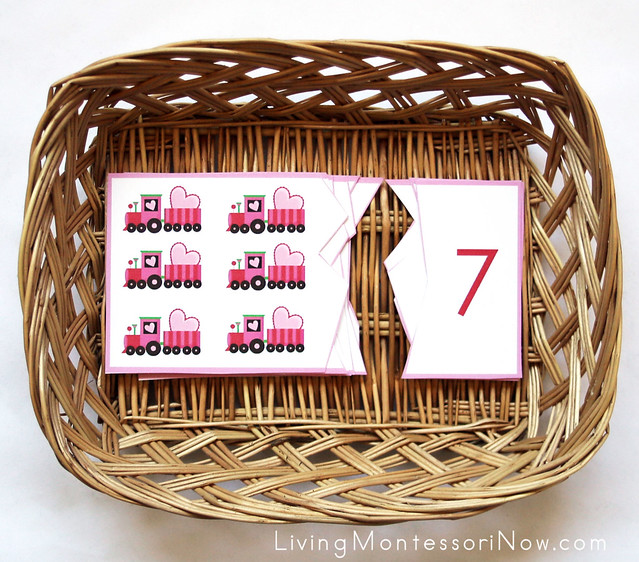
  Transportation Valentine Count and Match Puzzles 
I like the printable for this activity for vehicle lovers who might not be interested in traditional heart activities. It's the Valentine Number Puzzles from I Love Trucks, a Free Valentine’s Pack for Boys by Our Little Monkeys. 

The activity was very easy to prepare. It only required printing, laminating, and cutting the puzzle pieces. I used a Montessori Services basket (the small willow basket, which is my go-to basket for many card materials). 
 
Valentine Addition 

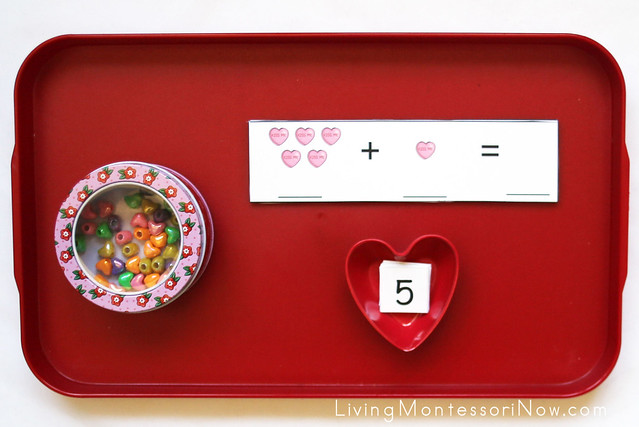
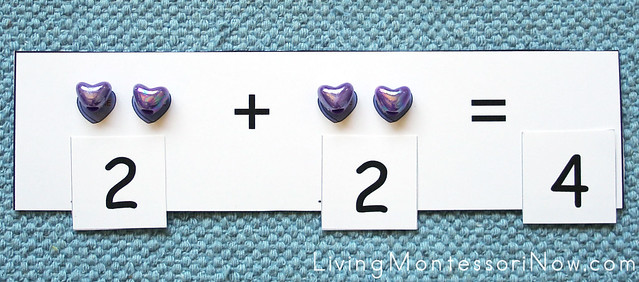
  Heart Addition Activity This activity uses the Valentine Addition printable from the Valentines Pack (part 3) by Cassie from 3 Dinosaurs along with the numbers from part 2 of the pack. 

I used iridescent heart-shaped pony beads that I thought were very pretty for this. The tray is the Montessori Services large plastic tray, which I use for many types of activities. I found the round container at a craft store a couple of years ago, so I don't know if it's still available. (Note: I really like the beads and buttons I found for these activities. They can be used for a variety of activities over a number of years.) 

You could add small tongs or tweezers for a practical life activity, although I think using fingers is great for fine-motor skills when working with the heart-shaped beads. It might detract too much from the addition work to use a tool with this activity since there are a number of addition problems in the printable. I counted out 10 of each color of bead so the child could complete any of the problems. 
 
Heart Addition Layout  

"Letter in the Mail" Beginning Sounds Activity 
  "Letter in the Mail" Beginning Sounds Activity 

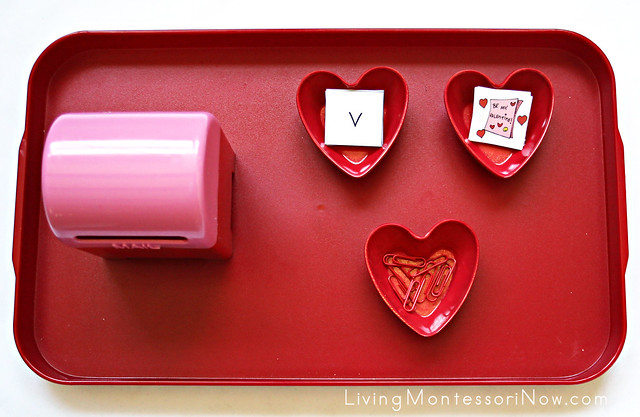
I used the "Letter in the Mail" printable from the Valentine Pre-K/K Pack {Updated and Expanded} by This Reading Mama. I cut apart the letters and pictures and added a valentine mailbox to make the activity extra appealing and hands-on. 

I think the valentine mailbox was from the Target dollar section a couple of years ago, but you could use any valentine mailbox that has a slot big enough for the cards in this activity. 

I added paper clips to the activity so the child can clip the matching picture to the letter. He or she could then "mail" the letter (letter with letter-sound picture). Continue until all the letters are mailed. 

You can learn more about introducing beginning sounds in my DIY Sandpaper Letters post. 

Here's the link to my favorite laminator ... inexpensive and great for almost any activity that needs to be laminated!
 
More Free Valentine Printables and Montessori-Inspired Valentine Activities

Go to my post at Living Montessori Now for links to valentine learning freebies from around the blogosphere: Free Valentine Learning Printables and Montessori-Inspired Valentine Activities.
Montessori at Home or School - How to Teach Grace and Courtesy eBookIf you'd like to focus on manners with children, please check out my eBook Montessori at Home or School: How to Teach Grace and Courtesy! It's written for anyone who'd like to feel comfortable teaching manners to children ages 2-12.

Have fun preparing for Valentine's Day!
Deb - SigantureLiving Montessori Now Button 
Deb ChitwoodDeb Chitwood is a certified Montessori teacher with a master’s degree in Early Childhood Studies from Sheffield Hallam University in Sheffield, England. Deb taught in Montessori schools in Iowa and Arizona before becoming owner/director/teacher of her own Montessori school in South Dakota. Later, she homeschooled her two children through high school. Deb is now a Montessori writer who lives in San Diego with her husband of 39 years (and lives in the city where her kids, kids-in-law, and baby granddaughter live). She blogs at Living Montessori Now.

Tuesday, January 13, 2015

Five New Years Resolutions for Teachers in 2015

RESOLUTION#1 - Refrain from using a loud voice
Children learn how to communicate by the models teachers set for them. As often as possible, when you need your children’s attention or cooperation, get to their eye level and speak in a calm and respectful tone. The more often you do this, the more likely you are to create peace and calmness in your classroom and your children will do the same.

RESOLUTION#2 – Use the word COOPERATION often
When you need your children to comply, initiate it by announcing, “I need your cooperation.”  When they follow through, thank them for cooperating with you.  When they need you do something for them, confirm their request by saying, “Oh… you need my cooperation.  I’d love to cooperate with you.”  Use that word in association with requests from other adults in the school so the kids will see it often.


RESOLUTION#3 – Let go and avoid controlling the outcome all the time
We’re constantly trying to get so much done in so little time and on schedule.  When children move too slow or don’t put a piece of clothing on correctly, it annoys us and we take over to have things according to our desire.  At least once a day, let something a child does be the way she did it.  Avoid correcting her, re-doing something, taking over for her, or arranging all the outcomes.

RESOLUTION#4 – Celebrate moments of independence
You’re getting ready to leave the classroom and you noticed that one child has buttoned her own jacket but the buttons are misaligned.  Or she put her coat on by herself but it’s inside out. For just once, avoid correcting the situation. Don’t re-button her jacket or adjust her sweater. Instead, make a big deal of what she did on her own. You can adjust things later but for the moment, celebrate her self-sufficiency.

How to Create Calmer Classrooms

RESOLUTION#5 – Stay calm when a child begins to argue
When a child becomes persistent in trying to convince us of something, we can easily get pulled into an emotional debate. Sometimes our own older children who feel they can approach us about anything and know they are being heard, consider their relationship with us stronger. Commit to not getting angry in these moments and be there 100%. If the child (or your own) has made a good case, give in once in a while if appropriate.  If you’ve had enough of the bantering, end it calmly and walk away. Know that it’s normal behavior.


Bill Corbett has a degree in clinical psychology and is the author of the award winning book “Love, Limits, & Lessons: A Parent’s Guide to Raising Cooperative Kids,” in English and in Spanish.  He is happily married with three grown children, three grandchildren, and three step children and resides in Connecticut.  You can visit his Web site www.CooperativeKids.com for further information and parenting advice.

Wednesday, January 7, 2015

Don't Wake The Bear! Let's Learn About Hibernation!


   Today was our first day back to school after our winter break and we are learning about animals that take a little break of their own during the winter. We are learning about hibernation! We talk about some of the many animals that we've learned about that hibernate---bears, some turtles, frogs, squirrels, rodents, skunks, bats, groundhogs, raccoons, and even some snakes and insects.  Tomorrow, we will make an anchor chart of these animals.


One of the favorite activities for hibernation with some of our "builders" is to have students build caves for the counting bears with legos. Somehow, I can't find a decent picture to share here but I will try to come back and add one later. We have also used marshmallows to build caves for gummy bears.


One of our math activities is making some simple caves with brown paper bags and having the students roll a dice to add the appropriate number of counting bears (or gummy bears, for even more interest). At the end, each student lifts the cave up and counts the total number of bears to compare with classmates.


Gummy bear graphing is another fun way to sneak a little math into learning about bears and hibernation.


Years ago, I made this little hibernation flannelboard set to go along with a little story I picked up somewhere. I think it may be from Jean Warren*(but I'm not sure).


The Bear and the Mountain
  by Jean Warren*
There once was a mountain
Who lived all alone.
He had no friends--
Not even a phone.
He smiled at planes
High in the sky.
But none of them stopped
As they flew by.
All through the winter
He was covered in snow
Then during summer
Wildflowers would grow.
He often saw people
Who came just to play.
But no one who came
Wanted to stay.
They were too busy---
Too much on the go.
Up they would climb,
Then down they would flow.
Then one fine day
Something paused and sighed.
As it huffed and it puffed
Up the mountain’s side.
Slowly up the mountain
Came a little brown bear
Wearing wildflowers
in her soft fuzzy hair.
“Hello, Big Mountain,
How do you do?
Can I please stay
This summer with you?”
“Of course,” said the mountain,
“It will be fun.
Run all you like
On my tummy-tum-tum.”
Little Bear was happy---
The mountain was, too.
Having a friend
Was something quite new.
Little Bear would race
Up the mountain’s side.
Then tumble and roll
And slip and slide.
All through the summer
Their friendship grew,
But then one day
The cold winds blew.
Now Little Bear
Knew that she had to go
Before the mountain
Was covered in snow.
“Please don’t go,”
The mountain cried.
“I’ll make a safe place
Where you can hide.”
He rumbled and rolled
And then cupped his arm
To make a warm shelter
All safe from harm.
Now Little Bear
Had a new home.
Now she would never
Have to roam.
Let the snow come---
She didn’t care.
She had a home
Just right for a bear.
The bear and the mountain
Were a sight to see,
Each with a friend,
Living happily.

Another one of our favorite activities is the "Hibernation Game", The children pretend to be hibernating. I give them a direction to wake up if they hear a certain cue. We start with using the names of animals that hibernate or don't hibernate. Sometimes, I will call out activities that will happen during the year. If a bear would miss it because of hibernation, they stay asleep, if they would not be hibernating during that time of year, they pop up and are "awake". Sometimes, I use pairs of words and rhyming words are the ones that will "wake the bears". The children love, love, love this game, so we find lots of ways to change it up and incorporate a variety of skills and knowledge.


Hibernation is part of a larger winter unit that we learn about. No winter unit would be complete without snow. We don't get very much snow in our area so we have to make our own snow activities and pretend that it is the real thing. One of the things we do frequently is using shaving cream "snow" as a sensory and fine motor experience. 


I saw this idea yesterday in one of our toddler rooms and thought it was brilliant! The toddlers will, of course, put everything into their mouths, so they are using whipped topping just as you would with shaving cream. The kids loved it!


Here are some of my favorite books about hibernation. Affiliate links are included for your convenience. 


Thanks for stopping by! Sending warm winter wishes from sunny (but chilly!) Georgia! 


**This post contains Amazon Affiliate links.  little illuminations is a participant in the Amazon Srvices LLC Associates Program, an affliate advertising program designed to provide a means for sites to earn advertising fees by advertising and linking to Amazon.com. **

I'm thrilled to say I have been blogging here on PreK+K Sharing since the very beginning!  I am a Ga. Pre-K teacher, serving 4 and 5 year olds in an inclusive setting. Stop by and visit me anytime at littleilluminations.blogspot.com where I share my PreK classroom adventures or visit the little illuminations fanpage on facebook! And be sure to check out PreK+K Sharing EEE!
Related Posts Plugin for WordPress, Blogger...